Recovering and Refining Platinum, Palladium & Rhodium
The transition toward a sustainable, low-carbon global economy has placed an unprecedented spotlight on a specific group of elements known as the Platinum Group Metals (PGMs). Among these, platinum, palladium, and rhodium stand out as the “big three”—critical industrial assets with unique chemical properties that make them indispensable in modern technology. As we move through 2026, the scarcity of these metals, coupled with their extreme economic value, has turned the focus from traditional mining toward the sophisticated science of recovery and refining.
The Value of the Noble Trio
Platinum Group Metals (PGMs) are a family of six noble metals: platinum (Pt), palladium (Pd), rhodium (Rh), ruthenium (Ru), iridium (Ir), and osmium (Os). They are defined by their exceptional catalytic properties, high melting points, and resistance to corrosion and oxidation. Platinum, palladium, and rhodium are the most commercially significant due to their ubiquitous presence in automotive and industrial systems.
Why Focus on Pt, Pd, and Rh?
These three metals are the primary drivers of the PGM market. While ruthenium and iridium have niche roles in electronics and electrochemical crucibles, the “big three” are the pillars of the global emissions-control industry. Their rarity is staggering; to put it in perspective, all the platinum ever mined would fit into a single Olympic-sized swimming pool.
Economic and Strategic Importance
The market for these metals is characterized by extreme price density. Rhodium, for instance, has historically seen price spikes that make gold look common by comparison. This economic weight is driven by three main factors:
-
Catalytic Converters: Over 80% of palladium and rhodium demand comes from the automotive sector.
-
The Hydrogen Economy: Platinum is the essential catalyst for Proton Exchange Membrane (PEM) fuel cells.
-
Electronics: Miniaturization in tech requires the high conductivity and stability of palladium.
As geopolitical tensions and mining costs rise, the “urban mine”—the collection of these metals from scrap—has become a strategic pillar for resource-poor nations.
Industrial Applications Driving Demand
Understanding the recovery process begins with understanding where these metals are used. The specific chemical “personality” of each metal dictates its application and, subsequently, the type of scrap material from which it is recovered.
Automotive Catalysts
The largest driver of PGM demand remains the automotive industry. Catalytic converters are designed to mitigate harmful pollutants from internal combustion engines (ICE).
-
Platinum: Traditionally used in diesel oxidation catalysts (DOC) to convert carbon monoxide and hydrocarbons into carbon dioxide and water.
-
Palladium: The primary workhorse for gasoline engines, where it facilitates the oxidation of unburnt fuel.
-
Rhodium: Often referred to as the most valuable of the three, rhodium is unmatched in its ability to reduce nitrogen oxides (NOx) into harmless nitrogen and oxygen.
Electronics and MLCCs
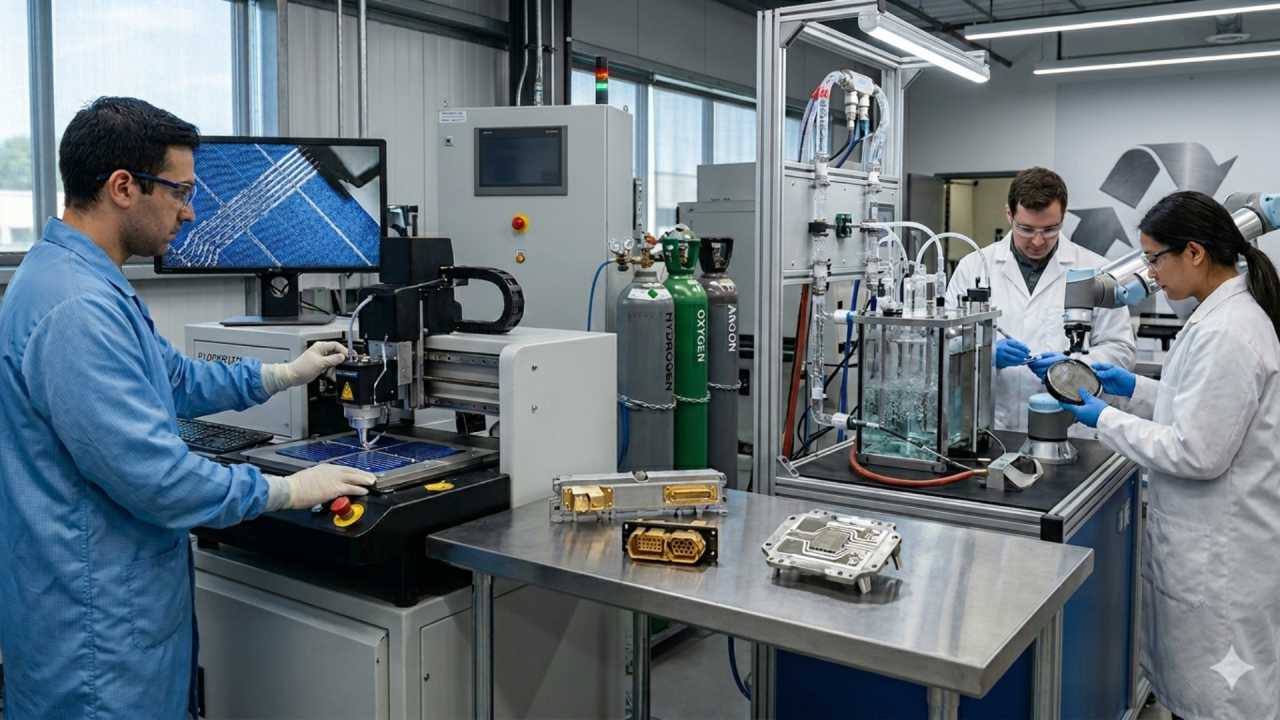
In the electronics sector, palladium is a key component in Multilayer Ceramic Capacitors (MLCCs). These components are found by the thousands in modern electric vehicles and high-end smartphones. Because these parts are so small, recovering the palladium requires advanced mechanical shredding and chemical leaching of circuit boards.
Chemical & Petrochemical Catalysts
The chemical industry uses PGMs in the form of “gauzes” or supported catalysts. Platinum-rhodium gauzes are used in the Ostwald process to produce nitric acid, which is the precursor for most global fertilizers. In oil refineries, platinum is used in catalytic reforming to increase the octane rating of naphtha into high-octane gasoline.
Jewelry & Investment
Platinum remains a staple in high-end jewelry due to its purity and “true white” luster. Unlike white gold, which is alloyed and plated, platinum is naturally white and does not fade. In the investment world, PGM bars and coins offer a hedge against inflation, creating a secondary market of “investment scrap” that enters refineries during periods of high metal prices.
Primary and Secondary Sources of PGMs
1. Mined (Primary) Sources
Primary production is concentrated in specific geological formations. The Bushveld Complex in South Africa accounts for roughly 70% of the world’s platinum supply. Other major regions include the Norilsk district in Russia, the Stillwater Complex in the United States, and the Sudbury Basin in Canada.
Mining these metals is energy-intensive and ecologically disruptive. Moving one ton of rock typically yields only 2 to 6 grams of PGM concentrate. This “grade” is significantly lower than what is found in recycled materials, highlighting the efficiency of the secondary market.
2. Secondary (Recycled) Sources
The “Urban Mine” is becoming the most reliable source of PGMs.
-
Spent Catalytic Converters: These represent the most significant secondary source, often containing PGM concentrations 100 to 500 times higher than natural ore.
-
Electronic Scrap (E-waste): Circuit boards and components contain small but recoverable amounts of palladium.
-
Industrial Catalysts: Large-scale chemical reactors provide bulk quantities of spent platinum and palladium catalysts.
-
Refinery Sweeps: In the jewelry and dental industries, even the dust from polishing floors (“sweeps”) is collected for PGM recovery.
Recycling is often more economically viable than mining because the “ore” is already refined to a high degree of concentration. For every ton of catalytic converter ceramic, refiners can recover kilograms of PGMs, compared to the mere grams found in a ton of raw earth.
Collection and Pre-Processing
The journey from a rusty exhaust pipe to a 99.95% pure metal bar begins with rigorous pre-processing. Because the value of the material is so high, accuracy in the early stages is critical.
Catalytic Converter Processing
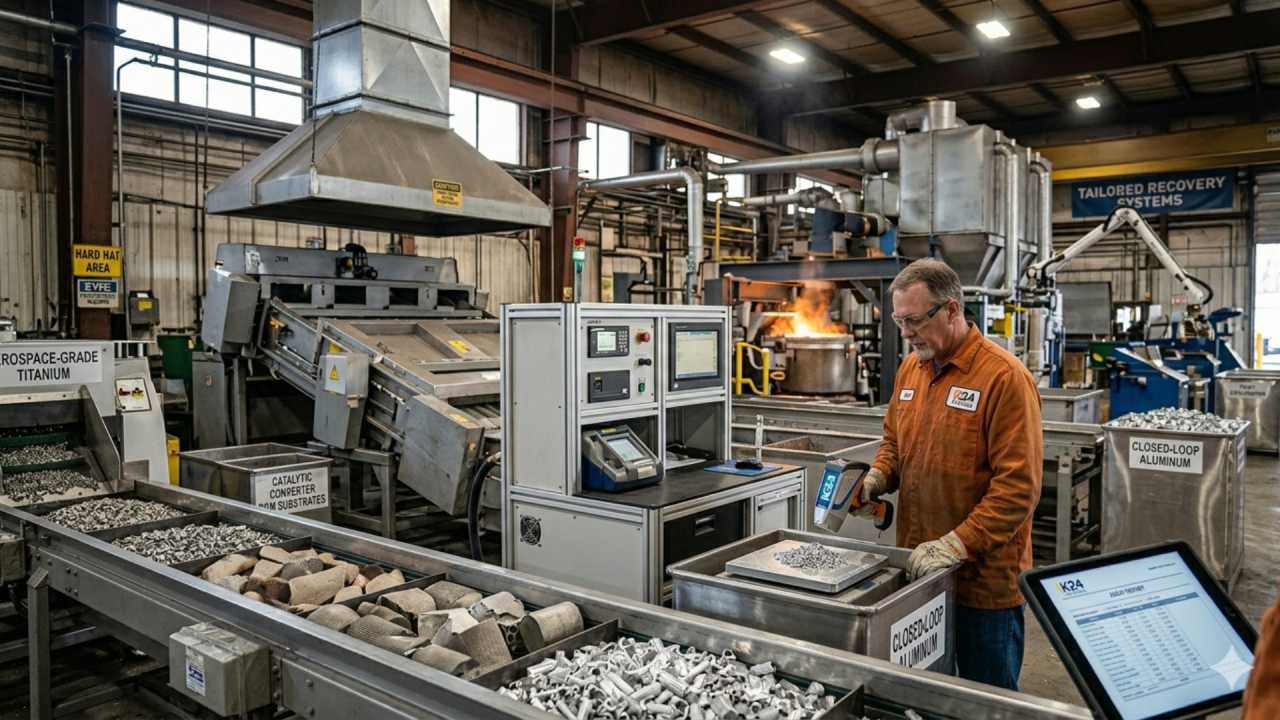
The first step is decanning, where the steel outer shell of the converter is sheared open to reveal the ceramic “honeycomb” monolith inside. This ceramic is then crushed and milled into a fine, flour-like powder.
The Importance of Sampling
In the PGM world, homogenization is everything. Because the precious metals are sprayed onto the ceramic substrate unevenly, a single handful of powder might not represent the whole batch. Refiners use “automated sampling” systems to take small increments of powder during the milling process to ensure a statistically significant sample.
Assaying Methods
-
X-Ray Fluorescence (XRF): Provides a rapid estimate of metal content.
-
Fire Assay: The traditional “cupellation” method where the sample is melted with a collector metal (like lead) to separate the precious metals.
-
ICP-OES: Inductively Coupled Plasma Optical Emission Spectroscopy is used for final, high-precision analysis.
Recovery Methods: Pyrometallurgical Processes
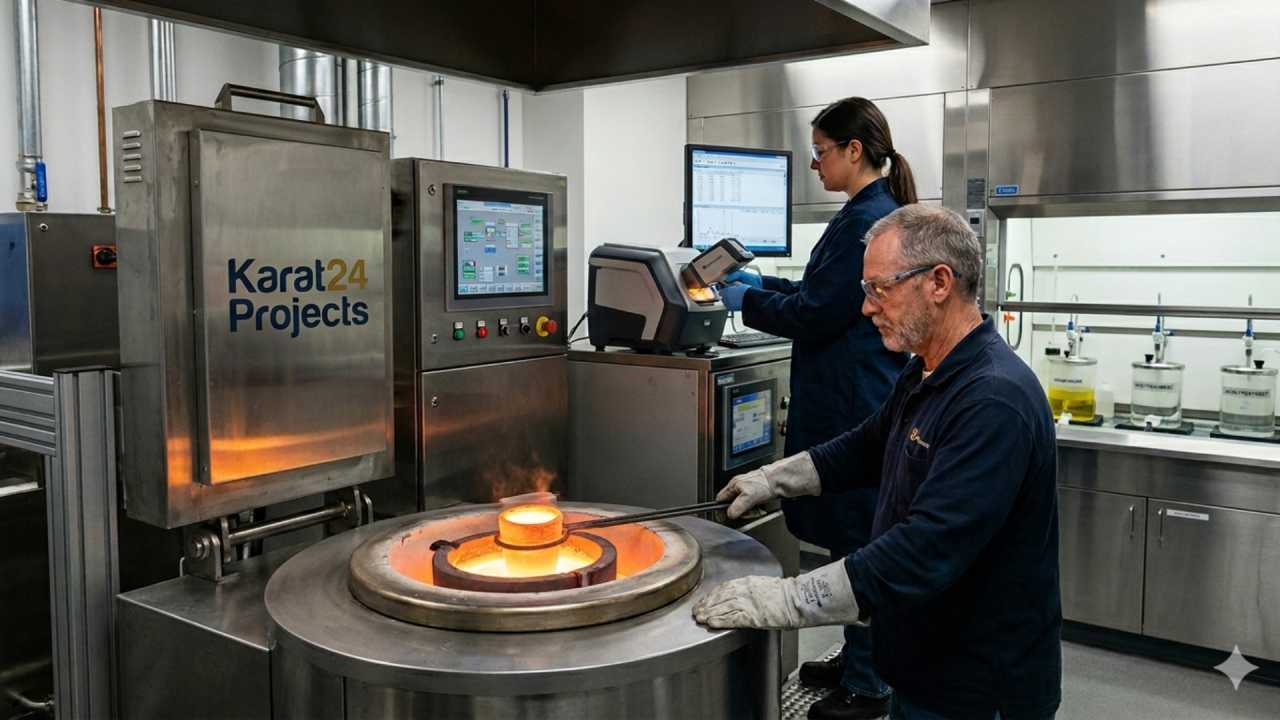
For large-scale industrial recovery, the pyrometallurgical route is often the first major step. This involves high-temperature furnace operations to separate the precious metals from the waste material (slag).
Smelting and Matte Formation
The milled PGM powder is mixed with fluxes (like lime or silica) and a “collector metal,” usually copper, nickel, or iron. When heated to temperatures exceeding 1,200°C, the mixture melts. The heavy precious metals bond with the collector metal to form a dense matte, while the lighter impurities (silica, alumina from the ceramic) float to the top as slag.
Advantages and Disadvantages
-
Pros: Smelting is robust. It can handle large volumes of “dirty” scrap, such as converters still containing some carbon or oil residue. It achieves recovery rates often exceeding 98%.
-
Cons: It is incredibly energy-intensive. Furthermore, the precious metals are now trapped in a copper or iron alloy and must be separated further using chemical means.
Hydrometallurgical Recovery Methods
This is the core technical phase where the individual metals are separated from one another through liquid chemistry.
1. Acid Leaching Systems
The goal of leaching is to turn solid metal into a liquid solution.
-
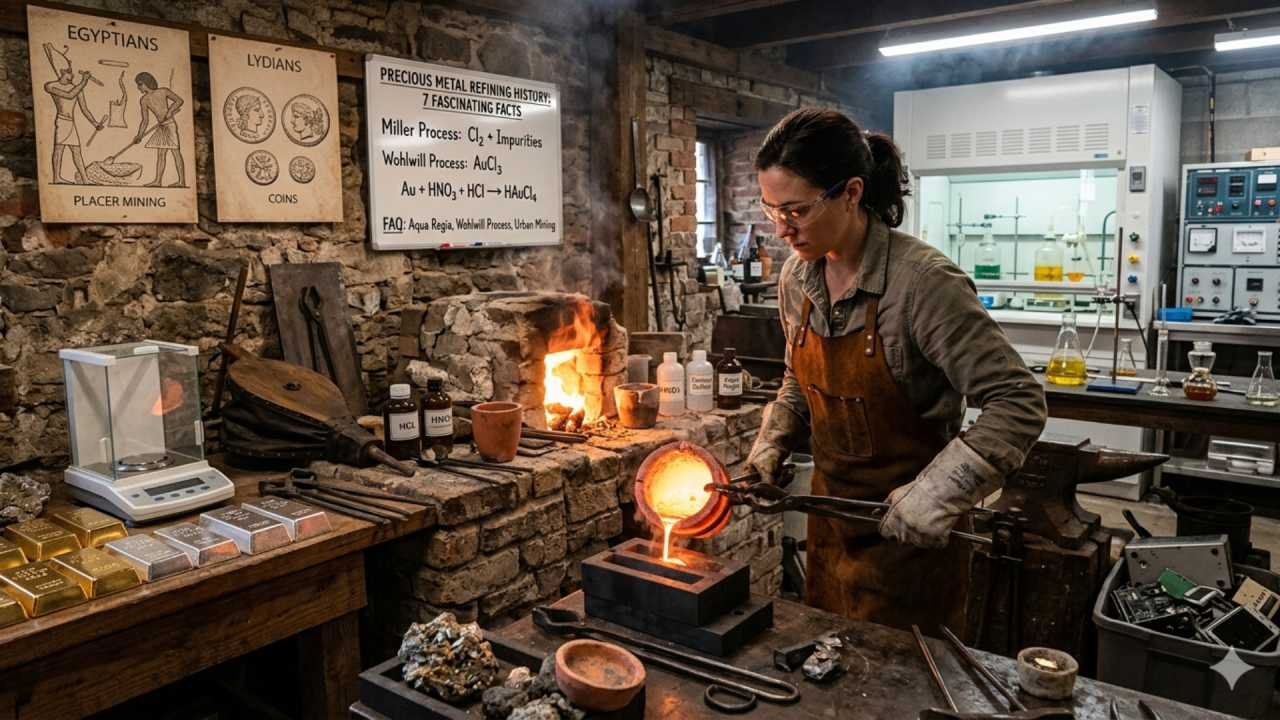
Aqua Regia: A potent mixture of nitric acid and hydrochloric acid ($HNO_3 + 3HCl$). The nitric acid acts as a powerful oxidizer, while the hydrochloric acid provides chloride ions to stabilize the metals in solution as chloro-complexes (e.g., $H_2PtCl_6$).
-
Chlorine/HCl Leaching: Many modern refineries avoid nitric acid to reduce toxic NOx emissions, opting instead for bubbling chlorine gas through hydrochloric acid.
2. Selective Precipitation
Once the metals are in a “pregnant” solution, they must be coaxed out one by one.
-
Platinum: Ammonium chloride ($NH_4Cl$) is added to the solution. This causes the platinum to precipitate as ammonium chloroplatinate, a bright yellow salt.
-
Palladium: After the platinum is filtered out, the remaining solution is treated with reagents like dimethylglyoxime (DMG) or by using an ammonia-based process to precipitate palladium.
-
Rhodium: Rhodium is the most chemically “noble” and stubborn. It often remains in the solution after Pt and Pd are gone. It usually requires complex reduction steps using zinc or specialized chemical “stripping” to isolate.
3. Solvent Extraction (SX)
SX is the more modern approach. It uses organic liquids (extractants) that have a specific chemical “key” to fit only one type of metal ion. When the organic solvent is mixed with the acidic water, the target metal “jumps” into the organic phase. This allows for nearly 100% selectivity, resulting in much higher purity levels than simple precipitation.
4. Ion Exchange Resins
Specialized resins act like “chemical magnets” to trap trace amounts of PGMs from wastewater or low-grade leach liquors. This is often the final “polishing” step to ensure no value is lost to the drain.
Refining to High Purity (99.95–99.99%)
The precipitates gathered from the previous stages are chemical salts, not yet the shiny metals we recognize.
Thermal Decomposition
The purified salts (like ammonium chloroplatinate) are placed in a furnace. Under high heat, the ammonia and chlorine are driven off as gases (which are captured by scrubers), leaving behind a porous, grey metallic mass known as sponge.
Powder to Ingot
The sponge is then melted—often using high-frequency induction melting to avoid contamination—and poured into molds.
-
Industrial Grade: 99.95% purity is standard for most catalytic applications.
-
Investment/Lab Grade: 99.99% (four-nines) is required for high-end electronics and bullion.
Final Assay and Certification
Every batch is sampled one last time. In the global market, refiners must be “Good Delivery” certified by the London Platinum and Palladium Market (LPPM). This certification ensures that a bar produced in South Africa is identical in quality to one produced in Germany or the USA.
Environmental & Safety Considerations
Refining PGMs is a hazardous undertaking. The process involves some of the most corrosive acids known to science.
-
Gas Emissions: Dissolving metals in aqua regia produces thick, orange clouds of NOx (nitrogen oxides). Refiners must use multi-stage “wet scrubbers” to neutralize these gases before they reach the atmosphere.
-
Wastewater: The leftover “barren” solution contains heavy metals and high acidity. It must be neutralized with lime and treated to remove all traces of toxins.
-
Sustainability: Recycling PGMs has a carbon footprint roughly 90% smaller than primary mining. As carbon taxes increase in 2026, the shift toward “green” recycled platinum is accelerating.
Economic Considerations
The PGM refining industry operates on thin margins but deals with massive value.
Volatility and Yields
A 1% drop in recovery yield on a large batch of rhodium can result in hundreds of thousands of dollars in lost revenue. Therefore, refiners invest heavily in “assaying” to ensure they aren’t paying for more metal than they can actually recover.
Hedging
Because the refining process can take 4 to 8 weeks, the price of the metal might drop significantly while it is still in the acid tanks. Refiners use hedging—selling the metal on the futures market at the moment they receive the scrap—to protect themselves from price swings.
Emerging Technologies & Future Outlook
The future of PGM recovery is moving toward “greener” and more automated solutions.
-
Bio-leaching: Using specialized bacteria to “eat” the base metals or even dissolve the PGMs, eliminating the need for harsh acids.
-
Deep Eutectic Solvents (DES): A new class of “green” solvents that can dissolve noble metals at lower temperatures with less environmental impact than aqua regia.
-
The Hydrogen Push: As the world moves toward green hydrogen, the demand for platinum (for electrolyzers and fuel cells) will shift. The industry is already designing recovery systems for “spent fuel cells,” which will be the “catalytic converters” of the 2030s.
Final Thoughts
The recovery and refining of platinum, palladium, and rhodium is a masterclass in industrial chemistry and economic strategy. By turning yesterday’s waste into tomorrow’s high-tech catalysts, the refining industry closes the loop on some of the rarest and most vital materials on Earth.