
For Businesses: Precious Metals Refining and Recovery
The global landscape of industrial production and resource management is undergoing a significant shift. For decades, the linear model of “take-make-dispose” dominated the corporate world. However, as the scarcity of raw materials increases and environmental regulations tighten, businesses are turning toward a circular economy. Central to this transition is the refining and recovery of precious metals. Gold, silver, platinum, and palladium are no longer just commodities traded on financial exchanges; they are vital components of modern technology, automotive systems, and medical devices. For businesses, mastering the recovery of these metals from scrap, industrial waste, and end-of-life products is no longer just an environmental gesture—it is a strategic economic necessity.
The importance of refining and recovery lies in its dual impact on profitability and sustainability. From a financial perspective, the internal recovery of precious metals can significantly reduce the cost of raw materials and create new revenue streams from what was previously considered “waste.” Environmentally, urban mining—the process of reclaiming metals from used products—requires a fraction of the energy compared to traditional mining and prevents hazardous materials from entering landfills. As we look toward the future, businesses that integrate robust refining processes into their operations will find themselves more resilient against supply chain disruptions and better positioned to meet the growing consumer demand for ethically sourced materials. This article explores the multifaceted world of precious metals refining, providing a comprehensive guide for businesses looking to optimize their recovery strategies.
Understanding Precious Metals
To build a successful recovery strategy, a business must first understand the specific characteristics of the metals it handles. The most commonly refined precious metals include gold, silver, platinum, and palladium. While gold and silver are well-known for their roles in jewelry and investment, their industrial utility is immense. Gold is a superior conductor that does not corrode, making it essential for high-end electronics. Silver possesses the highest electrical and thermal conductivity of any element, found in everything from solar panels to printed circuit boards. Platinum and palladium, part of the Platinum Group Metals, are indispensable in the automotive industry for catalytic converters and in the chemical industry as catalysts.
In a business context, these metals are rarely found in their pure form. They are typically embedded within complex assemblies or alloyed with base metals like copper, nickel, or zinc. Common sources include electronic waste (circuit boards, connectors, and processors), jewelry scrap (casting trees, polishing dust, and old inventory), industrial catalysts used in oil refining, medical devices such as pacemakers or catheters, and manufacturing waste from plating shops. The key characteristics that affect recovery efficiency include the initial purity of the scrap, the chemical composition of the host material, and the presence of alloying elements. Understanding these variables is crucial because the presence of certain impurities can complicate the refining process, requiring more advanced chemical treatments or multiple stages of smelting to achieve the desired high-purity output.
The Business Case for Refining and Recovery
The economic incentives for precious metals recovery are compelling. For many manufacturing and technology firms, the cost of purchasing “virgin” metals is one of their largest overhead expenses. By implementing a closed-loop recovery system, a company can reclaim a substantial portion of its own production scrap, effectively lowering its per-unit material cost. Furthermore, for companies that do not use precious metals in their primary products but generate them as a byproduct—such as electronics recyclers or automotive dismantlers—recovery transforms a disposal cost into a significant revenue center.
Beyond direct financial gain, recovery reduces a business’s dependence on volatile global mining markets. Geopolitical tensions or labor strikes in mining-heavy regions can lead to sudden price spikes or supply shortages. A business that relies on recovered metals is better insulated from these external shocks. Additionally, the Environmental, Social, and Governance (ESG) benefits are substantial. Modern consumers and investors increasingly favor companies that demonstrate a commitment to Corporate Social Responsibility. By reducing the need for destructive mining practices and lowering the carbon footprint associated with metal production, businesses can enhance their brand reputation and meet the stringent sustainability reporting requirements often demanded by regulatory bodies and shareholders alike.
Collection and Sorting of Scrap Materials
The journey of precious metal recovery begins long before the material reaches a furnace or a chemical tank. It starts with the meticulous identification and collection of recoverable scrap within the business facility. Many companies lose thousands of dollars annually simply because they do not recognize where their precious metals are hiding. For instance, in a jewelry manufacturing setting, gold can be found in the floor sweeps, the water from sink traps, and even the air filters of the ventilation system. In an electronics plant, “punched out” sections of gold-plated frames or discarded solder paste are rich sources of value.
Best practices for collection involve establishing a clear protocol for every department. This includes providing dedicated, labeled containers for different types of scrap to prevent cross-contamination. Sorting is perhaps the most critical step in maximizing recovery efficiency. Mixing different types of metals—such as putting silver-plated copper in the same bin as gold-plated pins—can lower the overall grade of the material and increase the complexity and cost of the refining process. Furthermore, businesses must navigate safety and regulatory considerations during collection. Some scrap materials may be classified as hazardous waste due to the presence of lead, mercury, or volatile organic compounds. Proper storage in leak-proof containers and adherence to local environmental laws ensure that the recovery process remains compliant and safe for employees.
Refining Methods and Technologies
Once the scrap material is collected and sorted, it must undergo refining to separate the precious metals from impurities. There are several primary technologies used in the industry today, each with its own set of advantages and limitations.
Chemical Refining
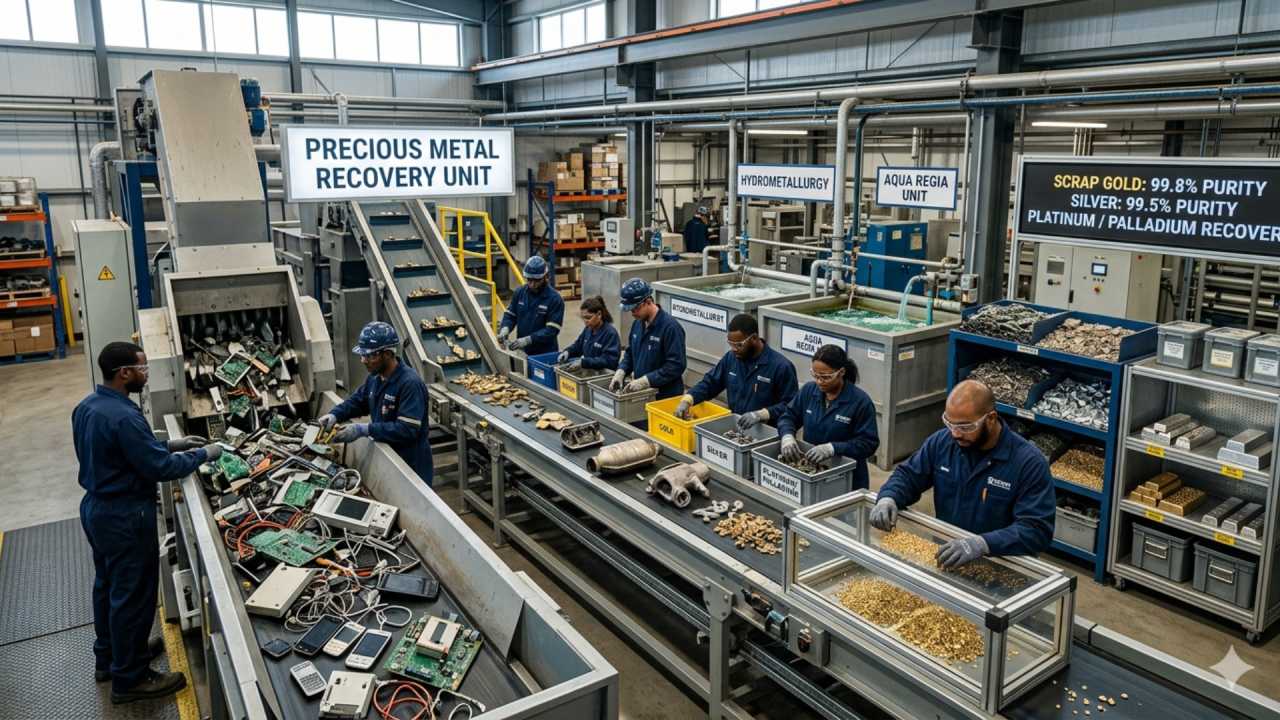
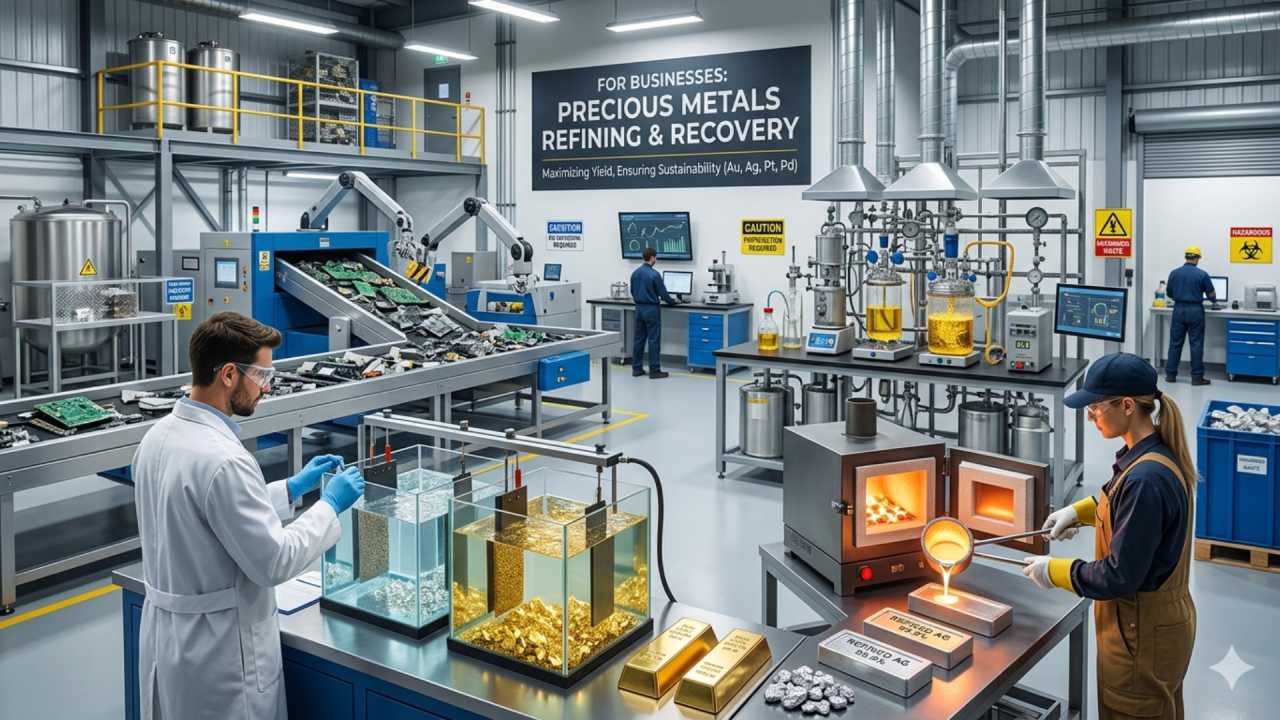
Chemical methods are widely favored for their ability to produce exceptionally high purity levels. The most famous of these is the aqua regia process, which involves a mixture of acids to dissolve gold into a liquid state, allowing impurities to be filtered out before the gold is precipitated back into a solid form. Nitric acid processes are commonly used for silver recovery, particularly from silver-copper alloys. While highly effective, chemical refining requires sophisticated fume scrubbing systems and careful handling of corrosive substances to ensure environmental safety.
Electrolytic Refining
This process uses an electric current to migrate metal ions from an impure anode to a pure cathode through a chemical solution. In gold refining, this is often known as the Wohlwill process, while in silver refining, it is the Moebius process. The main advantage of electrolytic refining is the extreme purity of the final product (often 99.99%). However, it is a slower process than chemical refining and requires a significant upfront investment in electrical infrastructure and specialized tanks.
Fire Assay and Smelting
Smelting is a traditional pyrometallurgical method where scrap is melted with fluxes in a furnace. The fluxes react with impurities to form a slag that floats on top of the molten metal, which can then be skimmed off. Fire assay is a specialized version of this used primarily for testing the purity of a sample. Smelting is highly efficient for processing large volumes of low-grade scrap or materials with high concentrations of organic contaminants that can be burned off.
Emerging Technologies
The industry is currently seeing a surge in eco-friendly innovations. These include bio-leaching, which uses specific bacteria to extract metals, and the development of non-toxic chemical solvents that replace traditional acids. Additionally, digital monitoring and automated sorting systems powered by artificial intelligence are helping businesses track their yields in real-time, reducing human error and optimizing the recovery of even the smallest traces of metal.
Recovery Processes in Industry
Different sectors have developed specialized approaches to precious metal recovery based on the nature of their waste streams. In the electronics industry, the focus is on “urban mining” from printed circuit boards (PCBs). These boards contain gold, silver, palladium, and copper. The process often involves mechanical shredding followed by a combination of magnetic separation and chemical leaching. Some of the most successful electronics manufacturers now partner with specialized refiners to ensure that every discarded device is stripped of its valuable components, creating a nearly circular supply chain.
In the automotive sector, the primary focus is the recovery of Platinum Group Metals from catalytic converters. Because these metals are present in very small quantities spread over a ceramic honeycomb structure, the recovery process involves sophisticated smelting and chemical separation. Automotive recyclers have become highly adept at identifying different converter types and sorting them to maximize the yield of palladium and rhodium, both of which have seen massive price increases in recent years.
The jewelry sector represents the most direct form of recovery. Many large-scale jewelers now operate small-scale in-house refining units. By processing their own bench sweeps and casting scrap, they avoid the fees and “metal loss” percentages typically charged by external refineries. These case studies show that regardless of the industry, the key to success is integrating recovery into the standard waste management workflow, treating scrap not as a nuisance, but as an inventory asset.
Quality Control and Assaying
In the world of precious metals, trust is verified by science. Assaying is the process of chemically or physically analyzing a material to determine its exact metal content and purity. For a business, accurate assaying is the cornerstone of the refining process. Without it, a company cannot know the true value of its scrap or the efficiency of its recovery efforts.
Several techniques are used depending on the required precision. X-ray Fluorescence (XRF) is a popular non-destructive method that provides a quick reading of the surface composition of a metal. While excellent for sorting, it may not detect inconsistencies deep within a bar. For high-stakes transactions, Fire Assay remains the gold standard for accuracy, involving the melting of a sample to separate the precious metal completely. For complex mixtures, such as those found in industrial catalysts, Inductively Coupled Plasma Mass Spectrometry (ICP-MS) is used to detect even trace amounts of metals at the parts-per-billion level. Consistent quality control ensures that the refined product meets international trade standards, such as those required for “Good Delivery” bars on the major bullion markets.
Regulatory and Environmental Considerations
Operating a refining or recovery process involves significant regulatory oversight. In many regions, agencies like OSHA (Occupational Safety and Health Administration) and the EPA (Environmental Protection Agency) set strict guidelines for the handling of chemicals and the management of emissions. Businesses must invest in advanced ventilation systems and acid-resistant flooring to protect workers from harmful fumes and accidental spills.
Hazardous waste management is another critical pillar. The byproducts of refining—such as spent acids or neutralized sludge—must be treated and disposed of through licensed hazardous waste contractors. Furthermore, businesses engaged in the trade of precious metals must often comply with “Conflict Minerals” regulations and Anti-Money Laundering (AML) laws. This requires a transparent “Chain of Custody” for all materials processed. Obtaining certifications such as ISO 14001 (Environmental Management) or becoming a member of the Responsible Jewellery Council can help a business demonstrate its commitment to ethical and sustainable practices, which is increasingly a requirement for doing business with major global brands.
Working with Refiners: In-House vs. Outsourcing
One of the most important decisions a business will face is whether to build an in-house refining capability or to outsource the work to a professional refinery.
In-House Refining
-
Pros: Lower long-term costs, immediate turnaround of metal, total control over the process, and elimination of shipping risks.
-
Cons: High initial capital investment for equipment, the need for specialized chemical expertise, and the burden of regulatory compliance and waste management.
Outsourcing
-
Pros: Low barrier to entry, access to the latest refining technologies without the overhead, and professional assaying services.
-
Cons: Refining fees and “treatment charges,” potential for metal loss during the process, and the time delay while waiting for the settlement.
When evaluating a professional refiner, a business should look for transparency in their pricing models and a proven track record of credibility. It is common practice to perform “split sampling,” where both the business and the refiner assay the material independently to ensure the results match. Ethical considerations are also paramount; a business must ensure that its refining partner adheres to the same environmental and labor standards that the business itself promotes.
Economic Trends and Market Outlook
The market for precious metals is characterized by both high value and high volatility. As of the mid-2020s, we are seeing a sustained demand for silver due to the global push for renewable energy (solar panels) and for Platinum Group Metals as hybrid vehicle production remains high. Gold continues to serve its historical role as a hedge against inflation and geopolitical instability.
Global supply chain disruptions have made local recovery even more attractive. As traditional mining becomes more expensive and difficult due to declining ore grades and rising energy costs, the “secondary supply” from recycling is becoming a larger percentage of the total market. Strategic insights for businesses suggest that the value of scrap will likely continue to rise. Companies that invest in recovery infrastructure now are essentially securing a future “mine” located right inside their own factories. By tracking market prices and timing their refining cycles, businesses can maximize their returns, selling their recovered metals when prices are high or holding them as a liquid asset on their balance sheet.
Best Practices and Recommendations
For businesses looking to optimize their precious metals recovery, several best practices stand out. First, maximize efficiency at the source. The cleaner the scrap and the better the sorting, the higher the eventual yield. Second, embrace technology. Even small improvements in chemical filtration or furnace temperature control can result in a one or two percent increase in recovery—which, given the price of gold or palladium, can translate into tens of thousands of dollars.
Employee training is equally vital. Workers should be educated on the value of the materials they handle and the safety protocols required for their recovery. A culture of “zero waste” should be encouraged across the production floor. Finally, sustainability should be viewed as a long-term business benefit rather than a hurdle. Utilizing eco-friendly refining methods and maintaining transparent records not only satisfies regulators but also builds a brand that is ready for the future of the green economy.
Final Thoughts
The refining and recovery of precious metals represent a unique intersection where economic interests and environmental responsibility align perfectly. For businesses, the ability to reclaim gold, silver, and platinum group metals from their own operations is a powerful tool for cost reduction, revenue generation, and supply chain security. While the technical and regulatory requirements can be complex, the rewards for mastering these processes are substantial.
As we move forward, the traditional distinction between “waste” and “raw material” will continue to blur. Urban mining and sophisticated refining technologies are proving that the metals we need for the next generation of innovation are already in our hands—we simply need to recover them. By investing in efficient recovery strategies, businesses can protect their bottom line, enhance their reputation, and contribute to a more sustainable and prosperous global economy. The future of industry is not just in what we create, but in how effectively we reclaim and reuse the precious resources that make our modern world possible.