How to Build a Profitable Gold Refining Operation from Scratch
Gold has remained the ultimate store of value for millennia, transcending civilizations, economic collapses, and technological revolutions. In the modern era, the profitability of gold is no longer confined to those who mine it from the earth. As the “circular economy” gains momentum, gold refining—the process of purifying gold from scrap jewelry, industrial waste, and discarded electronics—has emerged as a highly lucrative venture for entrepreneurs and technical operators alike.
Building a gold refining operation from scratch is a complex but rewarding undertaking. It requires a unique blend of chemical expertise, logistical precision, and a keen understanding of global commodity markets. Unlike many manufacturing businesses, gold refining deals with a product that has instant liquidity; there is never a lack of buyers for 99.9% pure gold.
This guide is designed for the ambitious entrepreneur or small-scale operator looking to navigate the technical, legal, and financial hurdles of the industry. We will explore everything from the chemistry of aqua regia to the intricacies of environmental compliance, providing a roadmap to transform raw scrap into investment-grade bullion.
Understanding the Gold Refining Industry
At its core, gold refining is the process of removing impurities from gold-bearing materials to achieve a specific level of purity, typically 99.5% (commercial grade) or 99.9% (investment grade/24-karat). The industry sits as a bridge between the “secondary market” (scrap) and the “bullion market” (refined bars).
Types of Raw Materials
A successful refinery must diversify its intake. The three primary sources are:
-
Jewelry Scrap: This is the most common source for small-to-medium refineries. It includes broken chains, dental gold, and “old gold” traded in by consumers. The advantage here is the relatively high concentration of gold (usually 10k to 22k).
-
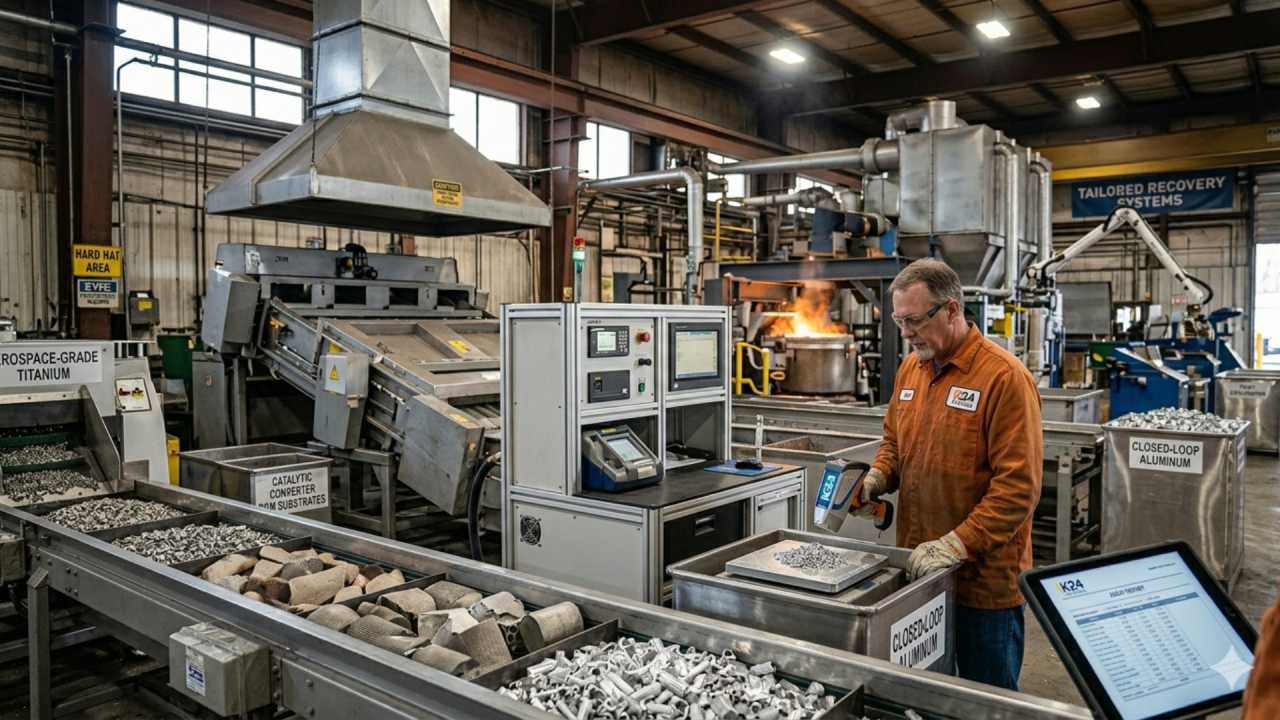
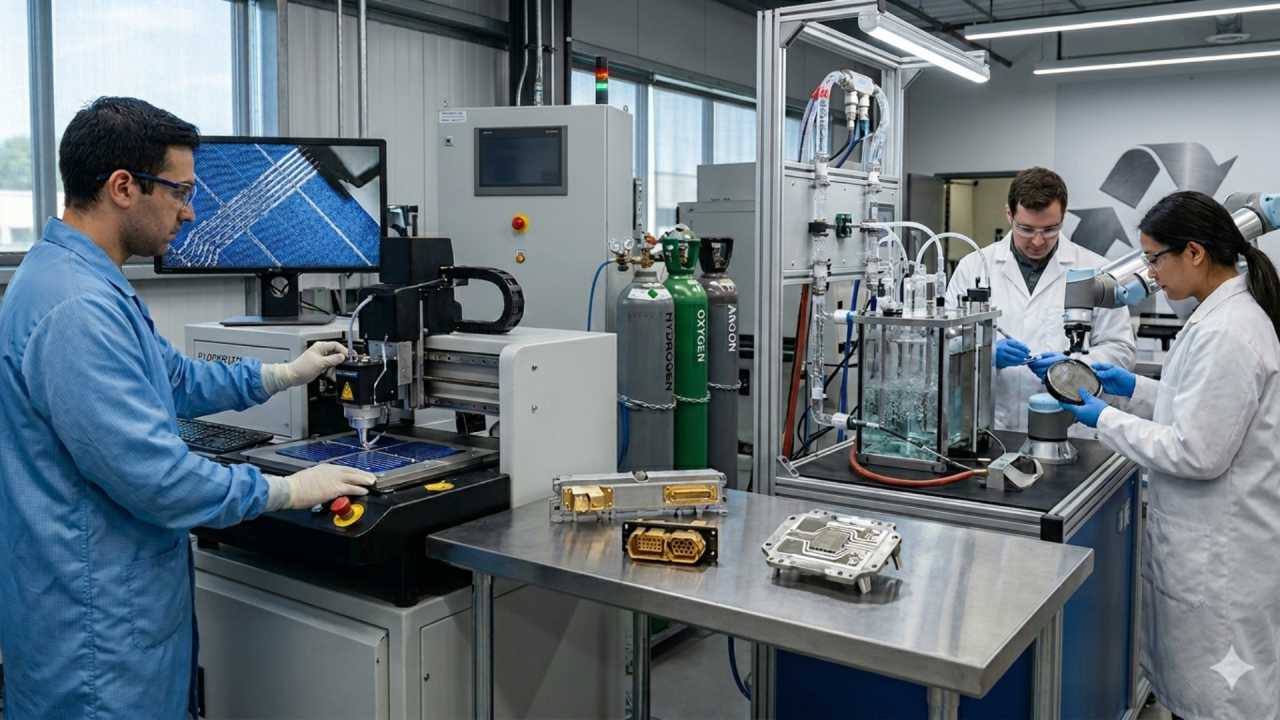
Electronic Waste (E-Waste): Computers, smartphones, and circuit boards contain gold in their connectors and processors. While the concentration is lower than jewelry, the sheer volume of e-waste makes it a massive growth sector.
-
Mining Byproducts: This includes “doré bars” from small-scale mining or “black sands” and concentrates that require final purification.
Refining vs. Trading
It is vital to distinguish between a gold trader and a gold refiner. A trader buys low and sells high without changing the form of the metal. A refiner adds value through a chemical or thermal process. Because refiners provide a technical service that increases the purity—and thus the marketability—of the metal, they often enjoy more stable margins than traders, who are purely at the mercy of daily price fluctuations.
Business Models in Gold Refining
Before purchasing your first furnace, you must decide which business model fits your capital and risk tolerance.
Toll Refining
In this model, the refiner does not own the gold. A client (such as a jewelry shop or a small mine) brings their scrap to you. You refine it into pure bars and charge a processing fee, often a combination of a flat rate per ounce and a small percentage of the recovered metal (the “retention”). This is a low-risk model because you are not exposed to the volatility of gold prices.
Buying and Refining
This is the “Full Stack” model. You buy scrap jewelry or e-waste outright, refine it, and sell the pure gold on the open market. This offers the highest profit potential because you capture the spread between the scrap purchase price and the spot price of pure gold. However, it requires significant working capital and exposes you to the risk of gold prices dropping while the metal is in your tanks.
The Hybrid Model
Most successful startups begin with toll refining to build a reputation and cash flow, then gradually begin purchasing their own scrap to maximize margins.
Legal and Regulatory Requirements
The gold industry is one of the most heavily regulated sectors in the world due to its association with money laundering and environmental hazards.
Licensing and Registration
You will need more than a standard business license. Most jurisdictions require a “Precious Metals Dealer” license. In the United States, for example, you must comply with the Anti-Money Laundering (AML) provisions of the USA PATRIOT Act, which includes “Know Your Customer” (KYC) protocols to ensure the gold you buy isn’t sourced from criminal activity.
Environmental Regulations
Refining involves hazardous chemicals like nitric acid and hydrochloric acid, which produce toxic fumes (nitrogen dioxide). You must obtain permits from environmental protection agencies regarding air emissions and wastewater discharge. Dumping spent acids down the drain is not just unethical; it is a federal crime in most nations that can result in immediate closure and heavy fines.
Hazardous Material Handling
You will need certifications for the storage and transport of corrosive chemicals. This includes specialized “hazmat” storage cabinets and rigorous safety training for all staff.
Setting Up Your Gold Refining Facility
Your facility’s layout can be the difference between a profitable operation and a dangerous liability.
Location and Zoning
Gold refineries should be located in industrial-zoned areas. High-security measures are obvious, but you also need to consider your neighbors. The “smell” of a refinery—even one with good scrubbers—is distinctive. Proximity to jewelry districts or industrial hubs can reduce transport costs and security risks.
Essential Infrastructure
-
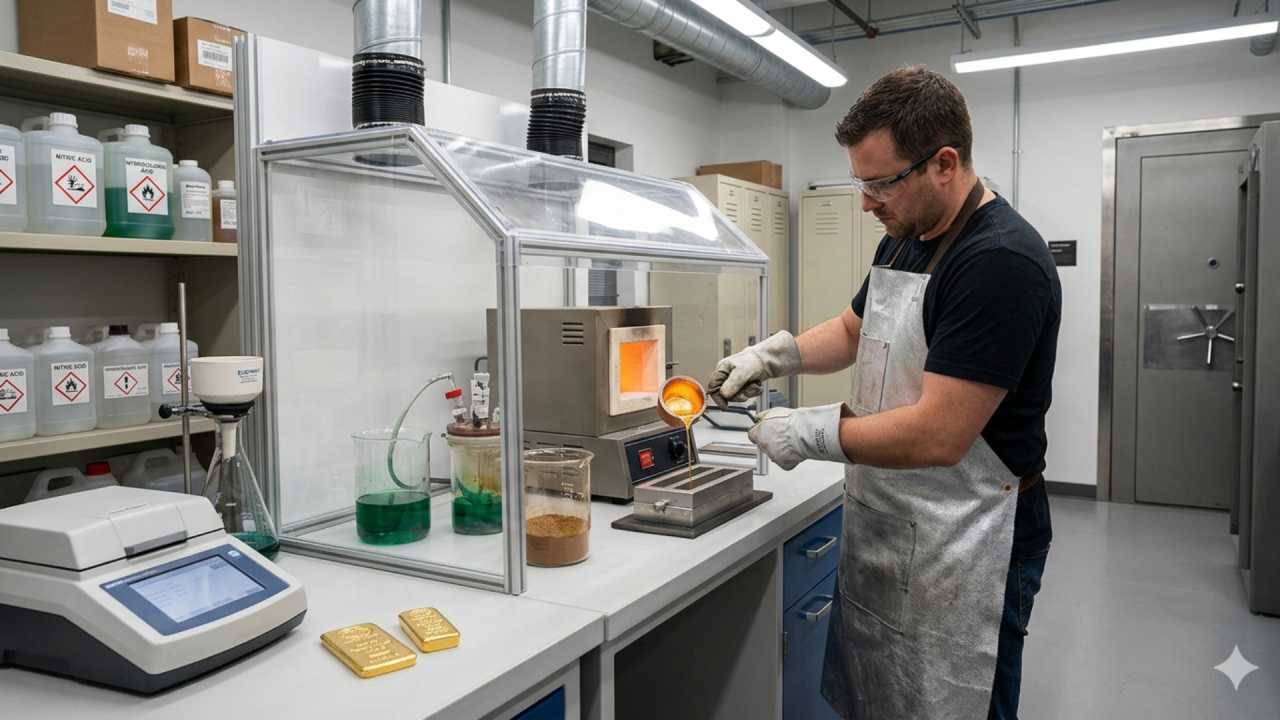
Ventilation and Scrubbing: A laboratory-grade fume hood is mandatory. For larger operations, a wet scrubber system is required to neutralize acid fumes before they exit the building.
-
Waste Treatment: You need an on-site neutralization system to treat acidic waste liquids, turning them into pH-neutral solutions that can be safely disposed of or processed for base metal recovery (like copper and silver).
-
Security: This includes reinforced vaults, 24/7 biometric access, and “man-trap” entry systems.
Equipment and Tools Needed
A professional refinery requires precision equipment. Cutting corners here leads to “gold loss,” where tiny percentages of your profit literally vanish into the air or the slag.
Core Equipment
-
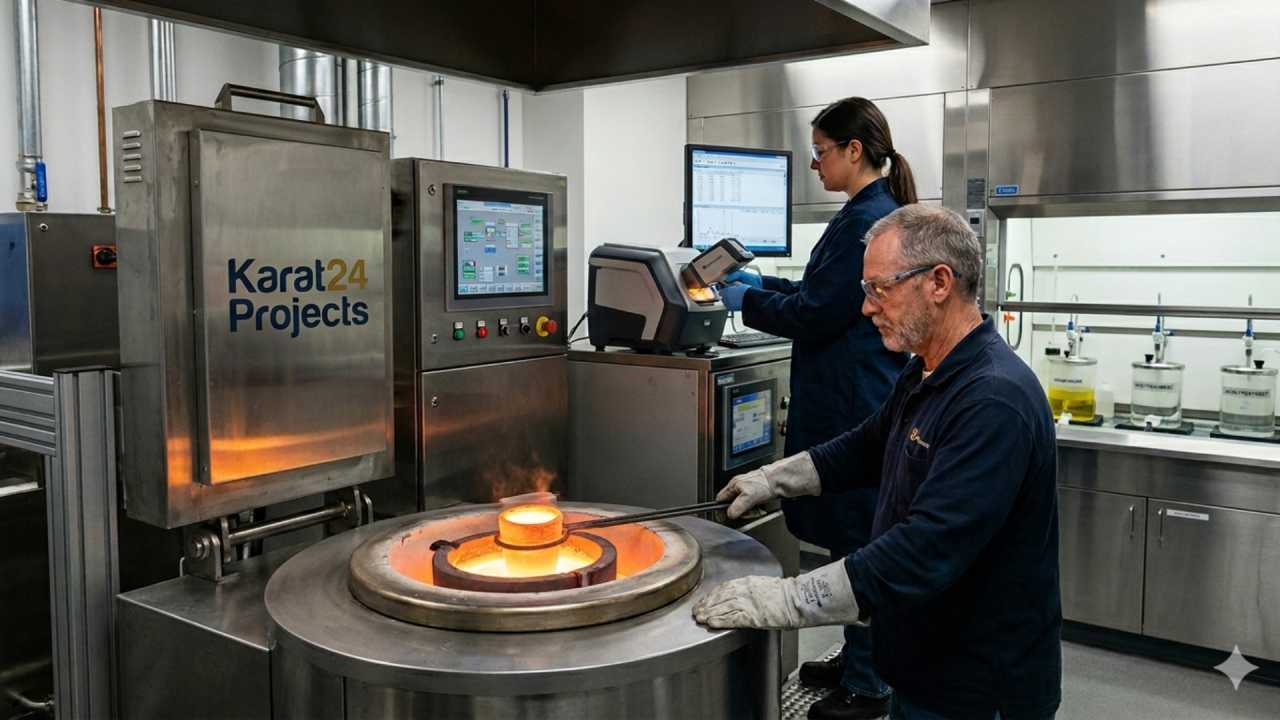
Induction or Propane Furnaces: For melting scrap into anodes or pouring final bars.
-
Refining Reaction Vessels: High-temp glass (borosilicate) or specialized plastic tanks capable of holding boiling acids.
-
Assaying Equipment: An X-Ray Fluorescence (XRF) analyzer is the industry standard for non-destructive testing, though fire assay remains the “gold standard” for ultimate precision.
-
Filtration Systems: Vacuum filters to separate pure gold mud from acidic solutions.
Estimated Startup Costs
A small-scale, professional boutique refinery (processing 1–5kg per week) can be started for $50,000 to $100,000, excluding the cost of the gold itself. Larger industrial setups can easily reach $500,000+ due to the cost of automated scrubbers and high-capacity induction melters.
Gold Refining Methods Explained
There are three primary methods used to reach high purity.
The Aqua Regia Method
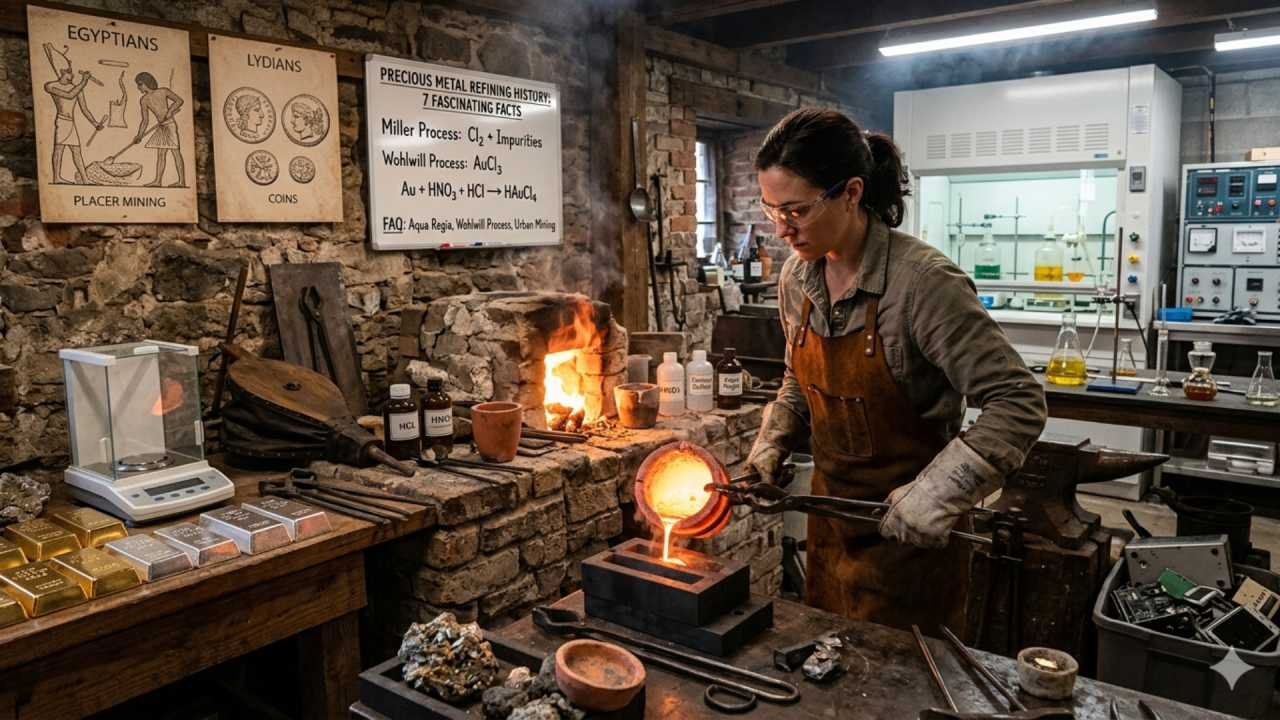
This is the most common method for small-to-medium operations. It involves dissolving gold in a mixture of hydrochloric acid and nitric acid (Aqua Regia, or “Royal Water”).
-
Dissolution: The scrap is dissolved into a liquid chloroauric acid.
-
Filtration: Silver and other insoluble materials are filtered out.
-
Precipitation: A chemical (usually Sodium Metabisulfite) is added to “drop” the gold out of the liquid as a brown powder.
-
Melting: The powder is washed and melted into a 99.9% pure bar.
The Miller Process (Fire Refining)
This involves bubbling chlorine gas through molten gold. The impurities (silver, copper, zinc) react with the chlorine to form chlorides that float to the top and are skimmed off. This is fast and efficient but generally only reaches 99.5% purity.
The Wohlwill Process (Electrolysis)
This is used by large-scale industrial refineries. It uses an aqua regia electrolyte and an electric current to migrate gold from an impure anode to a pure cathode. This achieves 99.99% purity (four-nines gold), which commands a premium price.
Sourcing Raw Materials
Without a steady “feed” of material, your refinery is just an expensive hobby.
Jewelry and Pawn Shops
These are your primary bread-and-butter suppliers. They buy from the public and need a reliable partner to turn that scrap into liquid cash. To win their business, you must offer faster turnaround times or better “payout percentages” than the large, distant industrial refineries.
E-Waste Recyclers
Developing partnerships with computer recycling centers can yield a steady supply of gold-plated pins and CPU chips. While the chemistry to extract gold from e-waste is more complex (involving more base metal removal), the “buy price” for this material is often much lower, leading to higher margins.
Building Trust
In the gold business, reputation is everything. Always provide a sample assay report and allow customers to witness the weighing of their material. Transparency is the only way to build long-term sourcing contracts.
Cost Structure and Profit Margins
Profitability in refining is a game of “basis points.”
Fixed vs. Variable Costs
-
Fixed: Lease, insurance (which is high for precious metals), security personnel, and regulatory compliance.
-
Variable: Acids, flux, crucibles, electricity (furnaces use a lot of power), and the “cost of carry” (the interest on the money used to buy gold).
Recovery Rates
A profitable refinery must achieve a recovery rate of 98% to 99.5%. If you lose 2% of the gold during the process—whether through fumes, spills, or poor chemistry—your entire profit margin for that batch is likely gone.
Example Scenario
If gold is $2,000/oz:
-
You buy scrap at 92% of spot ($1,840).
-
Refining costs (acids, power, labor) are $40/oz.
-
You sell refined gold at 99.8% of spot ($1,996).
-
Gross Profit: $116 per ounce.
-
Margin: ~5.8%.
Risk Management and Safety
Refining gold is inherently dangerous. You are working with high heat and chemicals that can cause permanent lung damage or death.
Chemical Safety
Nitric acid fumes can cause delayed pulmonary edema (fluid in the lungs). You must use high-quality respirators and ensure your ventilation system has a fail-safe. Always have acid-neutralizing spill kits on hand.
Fire and Explosion
Wet scrap should never be added to a molten crucible; the resulting steam explosion (the “molten metal explosion”) can be fatal. All material must be pre-heated and dried.
Theft and Security
Your inventory is essentially “unmarked cash.” Internal theft is often a bigger risk than external robbery. Implement strict “in-and-out” weighing procedures where every gram of gold is tracked from the moment it enters the door to the moment it leaves.
Marketing and Customer Acquisition
As a refiner, your “product” is actually your credibility.
Target Customers
Focus on high-volume, low-frequency clients first. A single industrial manufacturer that produces gold-plated components may provide more consistent work than twenty small jewelry repair shops.
Branding
Even though you are a chemical processor, your branding should reflect stability and luxury. Use high-quality certificates of assay. When a client receives a bar from you that is shiny, properly stamped with a serial number, and accompanied by a digital assay report, they feel secure.
Pricing Transparency
Develop a clear “Schedule of Charges.” Don’t hide fees in the “recovery loss.” Be upfront about your melting fees, assay fees, and the percentage you retain.
Scaling the Operation
Once your process is stable, scaling involves increasing your “throughput” without increasing your “gold loss.”
Automation
Invest in automated dosing pumps for acids and programmable induction furnaces. This reduces human error and ensures every batch is treated identically.
Expanding into Bullion
Rather than selling your gold back to a wholesaler, you can start minting your own branded investment bars or “rounds.” This allows you to capture an additional premium from retail investors who want to buy physical gold.
Partnerships
Partner with logistics firms that specialize in “valuable cargo” (like Brinks or G4S). This allows you to source material from across the country rather than just your local city.
Common Mistakes to Avoid
-
Ignoring the “Tails”: Many refiners focus only on the gold and throw away the waste liquids. These “tails” often contain significant amounts of silver and palladium. Over a year, this can be tens of thousands of dollars in lost revenue.
-
Underestimating Chemical Costs: The price of nitric acid can fluctuate wildly. If your process is inefficient and uses too much acid, your margins will evaporate.
-
Inadequate Assaying: If you buy a “gold” bar that is actually a thick gold plating over tungsten (which has the same density as gold), and your XRF doesn’t catch it, you will take a massive loss. Always use multiple testing methods for large purchases.
Final Thoughts
Building a gold refining operation is not a “get rich quick” scheme. It is a technical, disciplined business that rewards precision and integrity. By mastering the chemistry, adhering strictly to environmental and legal regulations, and building a brand based on transparency, you can carve out a highly profitable niche in the global gold market.
The barrier to entry is high, but that is exactly what protects your profit margins. For the entrepreneur willing to handle the acids, the heat, and the rigorous compliance, the rewards are as solid as the metal itself. Success in this field requires constant learning and an uncompromising commitment to safety and accuracy. Start small, refine your process, and let your reputation for purity pave the way for growth.