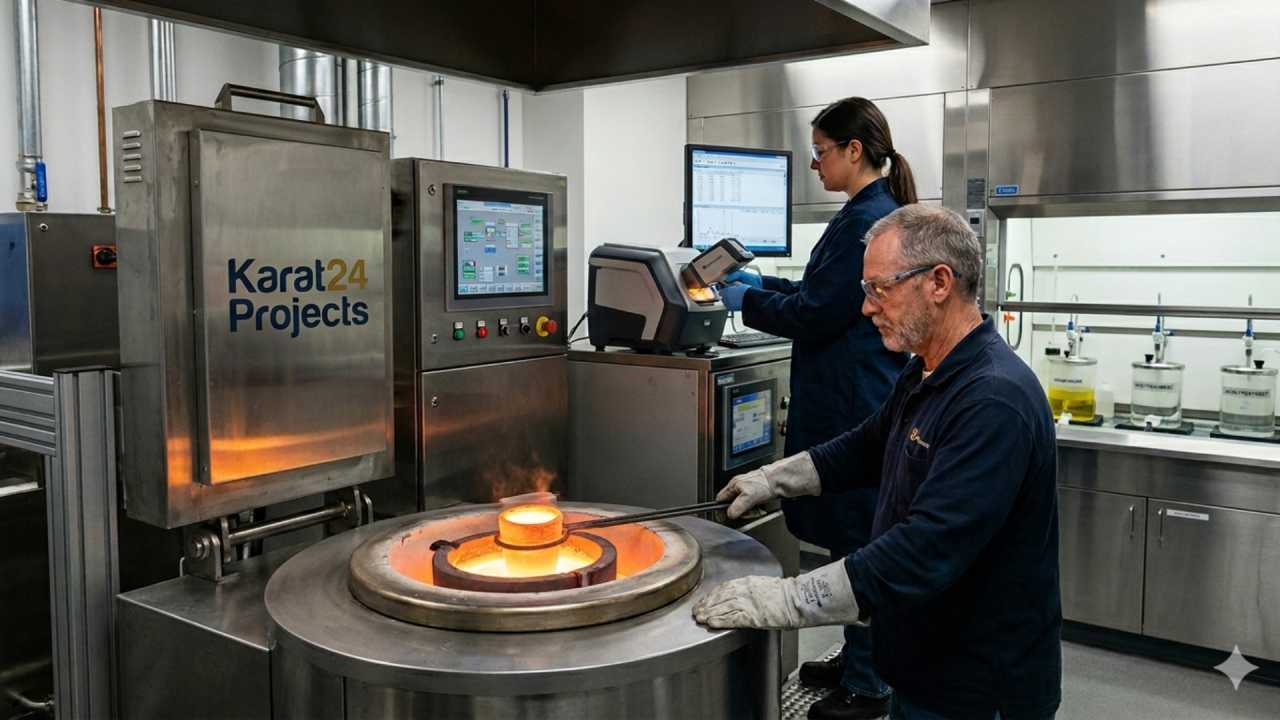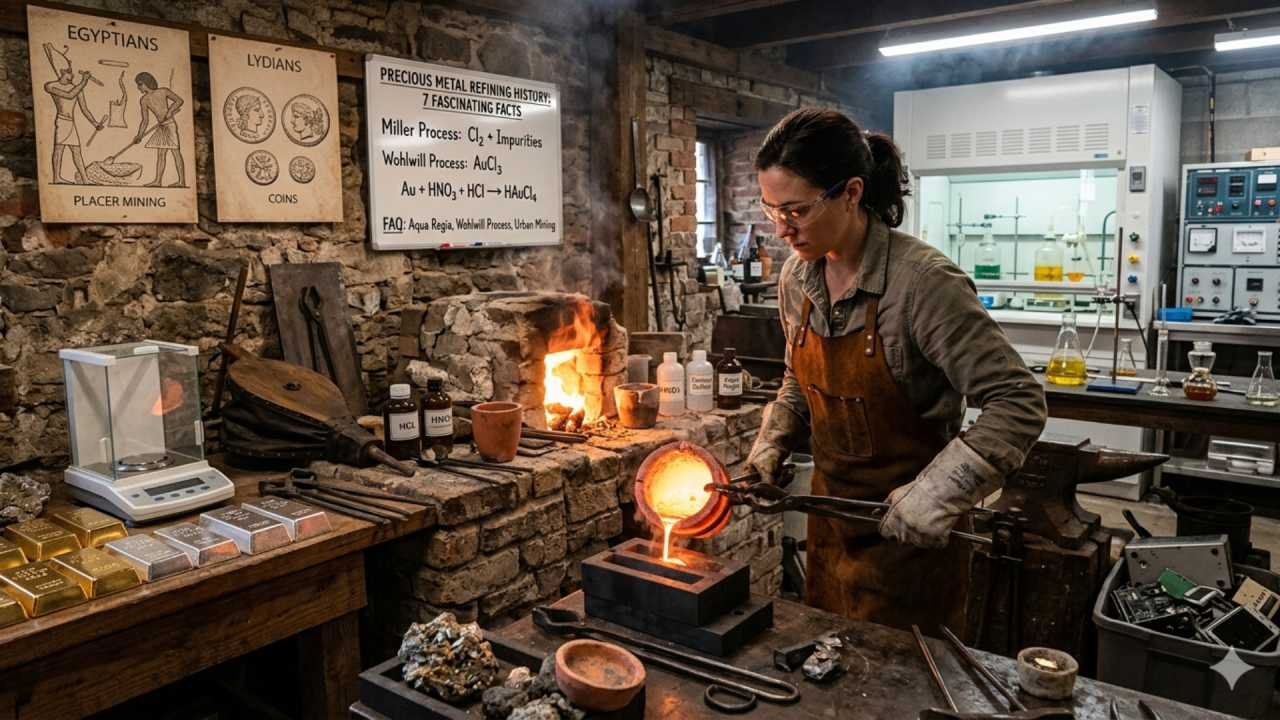
How to Fix Common Gold Refining Issues & Improve Gold Purity
Achieving the highest possible purity is the ultimate objective in precious metal refining. Whether you are processing industrial scrap, electronic waste, old jewelry, or mining concentrates, the margins of your operation depend directly on efficiency and final assay results. However, gold refining is a precise chemical and metallurgical journey. Even experienced refiners frequently battle systemic challenges: low purity levels, unexpected metal losses, stalled precipitation reactions, and stubborn base metal contamination.
When a refining batch falls short of expected purity standards, it is rarely due to a single catastrophic failure. Instead, it is usually the result of minor process deviations, accumulated contaminants, or improper chemical handling. Minor oversights can lead to fine gold particles escaping through filtration media, or base metals co-precipitating alongside your target material.
To run a profitable and consistent recovery operation, you must be able to diagnose exactly what goes wrong within your chemical reactions and thermal processes. This comprehensive guide breaks down the foundational science of gold refining, analyzes the most common root causes of low purity and metal loss, and provides actionable, industrial-grade troubleshooting steps to optimize your yield and achieve fine gold consistency.
Understanding Gold Refining Basics
Before addressing specific failures, it is essential to establish the scientific boundaries that separate recovery from true refining. While these terms are frequently used interchangeably in informal settings, they represent entirely different stages of precious metal processing.
-
Recovery is the mechanical or chemical act of collecting gold-bearing materials from a bulk source and concentrating them. Examples include stripping gold plating from circuit boards, panning gravity concentrates, or using selective acids to dissolve base metals away from a solid gold alloy. Recovery yields a concentrate, not pure metal.
-
Smelting is a thermal metallurgy process where gold-bearing scrap or concentrates are melted down with fluxing agents. The goal is to separate metallic elements from non-metallic rock, slag, and oxides. Smelting changes the physical form of the material and removes bulk dross, but it does not separate gold from other highly noble metals like silver or platinum group metals.
-
Refining is the precise chemical or electrochemical process of isolating gold from all other alloying elements, resulting in an elemental purity that meets commercial or investment-grade standards.
Primary Industrial and Laboratory Refining Methods
The choice of refining method depends heavily on the starting material, the volume of production, and the target purity. Four primary methodologies dominate the modern precious metals industry.
| Method | Typical Input Range | Target Purity Output |
| Aqua Regia | 60% to 90% Gold Alloys | 99.5% to 99.95% |
| Miller Process | Bulk Bullion/Mining Ore | 99.5% |
| Wohlwill Process | Greater than 95% Gold Anodes | 99.99% (Four Nines) |
| Electrolytic | Variable Precious Scrap | 99.9% to 99.99% |
The Aqua Regia process remains the most versatile and widely utilized method for small- to medium-scale operations. It relies on a mixture of hydrochloric acid and nitric acid to form volatile nitrosyl chloride and nascent chlorine, which aggressively attack gold to form soluble chloroauric acid.
The Miller process is an industrial-scale pyrometallurgical method. It involves bubbling gaseous chlorine through molten gold alloy. Base metals and silver react with the chlorine to form volatile or liquid chlorides that float to the top as a slag layer, leaving behind gold at roughly 99.5% purity.
The Wohlwill process is an electrochemical refining technique. It uses an electrolyte bath of chloroauric acid and hydrochloric acid. A lower-purity gold ingot serves as the anode, and pure gold sheets serve as the cathode. Under a direct electrical current, gold dissolves from the anode and deposits onto the cathode at ultra-high purities reaching 99.99%.
Common Sources of Gold Scrap
The matrix of impurities you must eliminate depends entirely on the material entering your facility.
-
Jewelry Scrap: Typically alloyed intentionally with copper, silver, zinc, and occasionally nickel or palladium to alter its carat value, hardness, and color.
-
Electronic Waste (E-Waste): Contains high concentrations of copper, nickel, iron, tin, and lead from solder, alongside trace amounts of gold plating.
-
Mining Concentrates: Dominated by iron sulfides (pyrite), arsenic, tellurium, lead, copper, and silicate rock minerals.
-
Industrial Scrap: Often includes braze alloys, silver solder, and complex platinum-group formulations used in aerospace or chemical catalysts.
Why Impurities Occur
Impurities persist in your final gold output because different elements exhibit varying chemical behaviors during dissolution and precipitation.
Silver complicates chemical refining because it reacts with chlorine to form silver chloride, an insoluble, sticky white precipitate that coats gold particles and prevents further acid attack.
Copper, nickel, zinc, and iron dissolve readily along with gold in aqua regia. If your chemical parameters shift during precipitation, these base metals can accidentally drop out of solution alongside your gold.
Lead and tin present severe challenges; lead forms poorly soluble lead chloride in cold hydrochloric acid, while tin forms metastannic acid, a gelatinous substance that can easily ruin filtration systems and trap dissolved gold.
Finally, Platinum Group Metals like platinum and palladium behave chemically like gold. They dissolve in aqua regia and will co-precipitate if the reducing agent or temperature is not strictly controlled.
Common Gold Refining Problems and Their Causes
When a refining batch fails to achieve its target purity or yield, methodical troubleshooting is required. Below are the seven most common problems encountered during the gold refining process, complete with their chemical causes and mechanical solutions.
Low Gold Purity After Refining
Discovering that your final gold button or bar tests well below 99.5% purity after a full refining run indicates a systemic breakdown in process cleanliness or chemical separation.
Root Causes
The primary driver of low purity is incomplete separation of base metals during the filtration step. If the pregnant solution (the acid containing the dissolved gold) is not perfectly clear before precipitation begins, suspended microscopic particulates of silver chloride or insoluble base metal salts will settle out with the gold powder.
Contaminated or industrial-grade technical chemicals can introduce dissolved iron, lead, or copper directly into the reaction.
Furthermore, dirty or shared equipment—such as using the same stirring rod or beaker for both raw scrap processing and fine gold precipitation—can introduce cross-contamination. Finally, if the gold powder is not washed properly after precipitation, trapped acidic salts will dry on the surface of the metal, oxidizing and turning into base metal inclusions during the final melt.
Corrective Actions
To fix low purity issues, you must enforce strict process isolation.
-
Use only high-purity, reagent-grade or laboratory-grade acids and distilled or deionized water for all chemical preparation and rinsing.
-
Implement a mandatory multi-stage filtration protocol: pass the pregnant aqua regia solution through a high-retention, quantitative filter paper until the liquid is clear and free of turbidity.
-
If a batch finishes below target purity, do not attempt to flux out the impurities during melting. Instead, re-granulate the low-purity gold by melting it and pouring it into water to form fine cornflakes, then run it through a second aqua regia refining cycle.
-
Maintain an isolated, dedicated clean zone for the final precipitation, washing, and melting steps.
Gold Does Not Dissolve Properly
When raw scrap or bullion is introduced to an aqua regia mixture and the reaction stalls, goes cold, or leaves behind large metallic chunks, your dissolution efficiency has failed.
Root Causes
A common cause is an incorrect or unbalanced aqua regia ratio. Gold requires an excess of chloride ions to stabilize it in solution, alongside sufficient nitric acid to act as the oxidizer. If your nitric acid is depleted, the dissolution stops.
Another major issue is passivation, which happens when the starting material contains more than 8% to 10% silver. As the aqua regia attacks the alloy, the silver immediately reacts with the hydrochloric acid to form a dense, impermeable crust of silver chloride on the surface of the metal. This crust blocks the acid from reaching the remaining gold beneath it.
Poor physical surface area—such as attempting to dissolve thick, solid ingots instead of thin ribbons or granulated shot—will also slow the reaction rate.
Corrective Actions
Always mix aqua regia using precise volumetric ratios, typically 4 parts hydrochloric acid (32% to 37%) to 1 part nitric acid (68% to 70%). When dealing with high-silver gold scrap, you must perform a pre-treatment step known as inquartation.
Melting the gold scrap with enough copper or silver to drop the gold content down to approximately 25% creates an alloy that can be digested in a hot, 50% nitric acid solution. This nitric acid treatment dissolves away the silver and base metals, leaving behind a highly porous gold sponge that dissolves rapidly in aqua regia.
Additionally, maximize the surface area of your starting material by granulating the molten metal into water or rolling it into thin ribbons before exposing it to the acid.
Poor Gold Precipitation
This issue occurs when you add your selective reducing agent to a clear, gold-bearing solution, but instead of dropping clean, heavy brown gold powder, the solution turns cloudy, remains bright green, or forms a muddy suspension that refuses to settle.
Root Causes
The single most frequent cause of failed or incomplete precipitation is an excess of residual nitric acid in the solution. Nitric acid is a powerful oxidizer. If there is unreacted nitric acid remaining when you introduce a reducing agent like Sodium Metabisulfite, the nitric acid will immediately re-oxidize and re-dissolve any gold powder trying to drop out of solution. This creates a continuous chemical loop that consumes your precipitant without recovering your gold.
Incorrect solution pH can also stall the reaction. If the solution is too highly diluted or lacks sufficient acidity, the reducing agent cannot function optimally.
Finally, adding an incorrect dosage or using degraded, damp precipitating chemicals will lead to incomplete recovery.
Corrective Actions
You must neutralize the unreacted nitric acid before introducing any precipitant. To do this, heat your pregnant aqua regia solution to a gentle simmer and add small increments of sulfamic acid. The sulfamic acid reacts with the free nitric acid to convert it into harmless nitrogen gas and sulfuric acid.
Continue adding sulfamic acid until the brown nitrogen dioxide gas fumes stop and the solution ceases to effervesce.
Alternatively, evaporate the solution down to a thick, syrupy state while adding small amounts of hydrochloric acid to drive off the nitric fumes.
Once the nitric acid is completely eliminated, dissolve your Sodium Metabisulfite in warm, distilled water and add it slowly to the solution while stirring. Always use a stannous chloride testing solution to confirm that all gold has dropped out before discarding any liquid.
| Reducing Agent | Typical Use Case | Selective Benefit |
| Sodium Metabisulfite (SMB) | Standard Aqua Regia processing | High selectivity over copper and nickel |
| Ferrous Sulfate | Industrial / Large scale refining | Very clean separation, slow settling time |
| Oxalic Acid | Ultra-high purity finishing runs | Does not precipitate platinum group metals; yields large gold crystals |
Gold Loss During Filtration
Gold loss during filtration directly impacts your recovery rate. This issue shows up as a discrepancy between your initial fire assays and the final weight of your physical gold button.
Root Causes
When gold drops out of solution via rapid chemical reduction, it often forms ultra-fine, colloidal particles rather than heavy, granular crystals. These microscopic particles can easily pass through the pores of standard or low-grade filter papers, sliding out with the barren acid waste.
Mechanical failures, such as a tear in a paper filter caused by excessive vacuum pressure or improper seating of the paper inside a Buchner funnel, will let unfiltered solution bypass the media completely.
In addition, failing to allow the precipitated gold powder adequate time to settle before pouring the liquid through the filter forces a high concentration of fine powder into the filter pores all at once. This blinds the filter and increases the risk of overflow or tearing.
Corrective Actions
To eliminate filtration losses, always allow your precipitation vessel to sit undisturbed for at least 8 to 12 hours after adding the reducing agent. This allows the fine gold powder to agglomerate into larger, heavier particles that settle completely to the bottom of the vessel.
When you begin filtration, use a decanting technique: pour the clear top liquid through the filter first, leaving the heavy mud at the bottom for the very end.
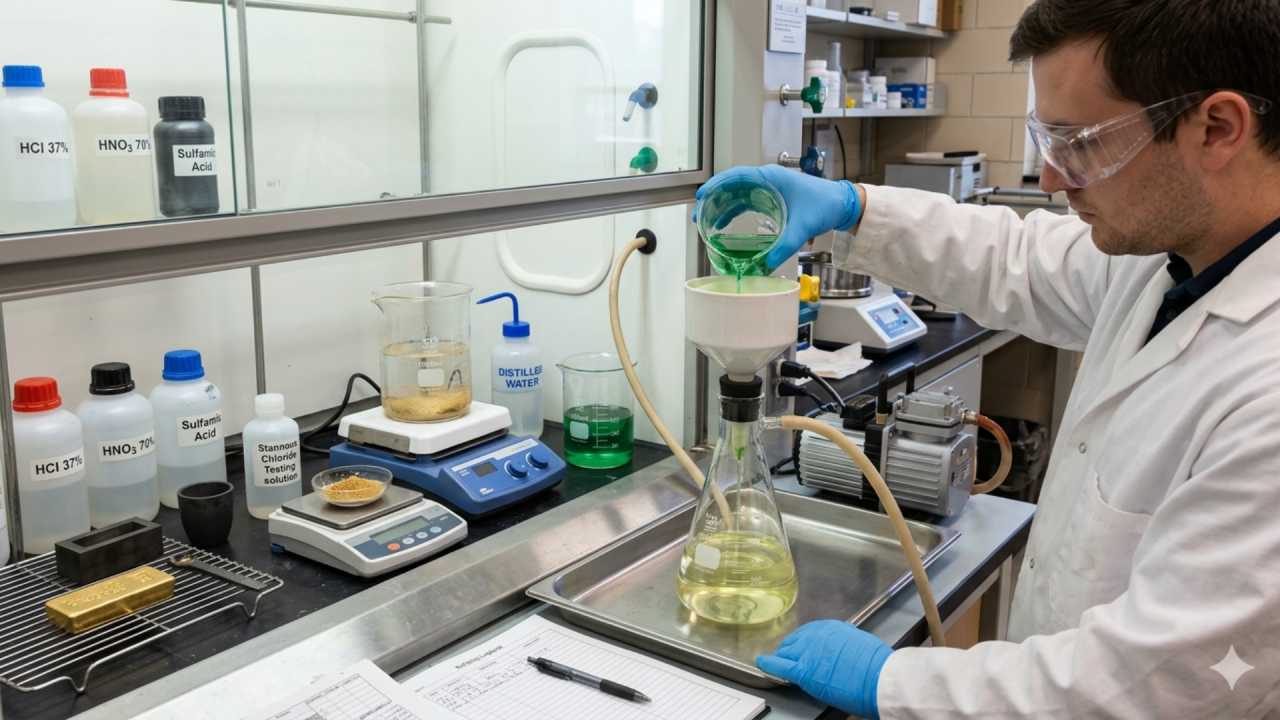
Utilize a vacuum-assisted filtration setup equipped with dual layers of high-strength, quantitative, ashless filter papers.
If you notice the filtrate liquid has a faint yellow or brown tint after passing through the filter, run it through a fresh, secondary fine-pore filter system immediately. Never discard waste solutions until a stannous chloride spot test confirms they are completely negative for dissolved gold.
Contamination from Base Metals
This problem occurs when your final gold powder contains high amounts of copper, zinc, lead, iron, or nickel. This leaves you with a brittle, discolored, or heavily oxidized gold button after melting.
Root Causes
Base metal contamination happens during chemical reduction when the solution contains high concentrations of non-precious metals alongside the gold. While reducing agents like Sodium Metabisulfite are highly selective for gold, an extreme excess of copper or iron in a crowded solution can cause these elements to drop out via mechanical entrapment or co-precipitation.
Lead is a common culprit. It dissolves in hot aqua regia but precipitates out as needle-like white lead chloride crystals as soon as the acid cools down. These crystals mix directly with your gold powder.
Tin behaves similarly; if it is not removed before the aqua regia step, it converts into a sticky, insoluble gel that traps base metal ions and sticks directly to your gold powder during filtration.
Corrective Actions
Implement a thorough mechanical and chemical pre-separation protocol before exposing your scrap to aqua regia. For electronics or heavily alloyed jewelry, treat the raw material with a boiling solution of 30% nitric acid or hydrochloric acid first. This selectively dissolves the bulk of the copper, nickel, zinc, and iron while leaving the gold intact.
If lead is present in your starting material, add a small volume of sulfuric acid to the aqua regia mixture. This converts the lead into highly insoluble lead sulfate, which can be filtered out while the solution is cold before you precipitate the gold.
Finally, ensure your precipitated gold powder undergoes a series of aggressive chemical washes before it ever reaches the melting crucible.
Black or Brown Gold Powder
Pure gold precipitated from a pristine chemical solution should appear as a heavy, light-brown or peanut-butter-colored powder. If your recovered powder emerges as a dark gray, charcoal black, or muddy dark brown sludge, it contains significant surface impurities.
| Powder Appearance | Indicated Condition | Required Action |
| Light Tan / Brown | High Purity (Greater than 99.9%) | Proceed to final distilled water wash and dry |
| Dark Charcoal / Black | High base metal or platinum group metal contamination | Hot hydrochloric acid wash or full re-refining run |
| Greenish-Brown Tint | Heavy copper entrapment | Hot nitric acid or ammonia rinse cycle |
Root Causes
Black or exceptionally dark gold powder indicates either a very small colloidal particle size or high surface contamination from oxidized base metals. If you add your reducing agent too quickly or at an extremely high temperature, the reaction proceeds too violently. This forces the gold to drop as microscopic particles that absorb light, making them appear black.
Alternatively, if the solution contains residual copper or nickel ions, these metals will coat the outer layer of the gold particles as they fall out of solution.
Insufficient washing of the wet gold powder allows these base metal salts to remain trapped inside the damp cake. When the powder dries, these salts oxidize, turning dark gray or black.
Corrective Actions
To restore purity to dark gold powder, you must perform a rigorous washing sequence.
-
Once precipitation is complete and the liquid is decanted, wash the gold powder with boiling distilled water to dissolve any residual sodium salts or chlorides.
-
Decant the water, then flood the powder with hot, concentrated hydrochloric acid. The hot hydrochloric acid dissolves any base metal oxides, copper chlorides, or iron salts coating the gold, often changing the solution to a bright green or yellow color while the gold powder lightens to a clean brown.
-
Rinse the powder with distilled water again, followed by a hot rinse with 10% nitric acid if platinum group metal contamination is suspected.
-
Wash a final time with distilled water until the rinse water tests completely neutral on a pH strip.
Melting Issues and Porous Gold Bars
When you melt your refined gold powder, it should flow smoothly like liquid mirrors and solidify into a dense, shiny ingot. If your metal spatters, smokes, forms a thick slag layer, or cools into a porous bar filled with voids and a dull green or black surface, your thermal processing is flawed.
Root Causes
Porous bars and melting issues are caused by gas evolution and entrapment. If your gold powder is not 100% dry when you charge it into a hot crucible, any residual moisture instantly turns into superheated steam. This causes the powder to erupt, spattering metal out of the crucible and creating gas pockets in the melt.
Trapped flux residues also cause issues; using too much borax or the wrong flux ratio can trap molten oxides within the metal rather than drawing them out to the edges.
Overheating the gold or exposing it to an oxidizing torch flame introduces dissolved oxygen directly into the liquid metal. As the gold cools and solidifies, this dissolved gas escapes, creating a network of pinholes, voids, and surface bubbles.
Corrective Actions
Before melting, place your washed gold powder into a glass or ceramic evaporation dish and dry it completely in an oven or on a hot plate at approximately 110 degrees Celsius until it is a bone-dry, free-flowing powder.
Pre-heat your high-purity graphite or clay-graphite crucible, and glaze the interior lightly with a small amount of anhydrous borax. Do not overload the melt with flux; clean gold requires only a minimal dusting of borax to protect it from atmospheric oxidation.
When using a gas torch, use a reducing flame (a clean, blue flame with no excess oxygen) and keep it moving consistently over the metal to prevent localized overheating.
Pour the molten gold smoothly and continuously into a clean, pre-heated, and lightly oiled graphite ingot mold to ensure rapid, uniform cooling without gas entrapment.
How to Increase Gold Refining Purity
To step up from basic recovery to high-purity gold production, you must optimize your entire process. Implementing these industrial controls ensures that your final assays hit 99.9% purity or higher on every single run.
| Target Purity | Common Use Case | Required Process Control |
| 99.5% (Two Nines) | Commercial Bullion / Standard Jewelry | Single Aqua Regia run with high quality filtration |
| 99.9% (Three Nines) | Investment Bars / Industrial Plating | Double Aqua Regia pass plus rigorous hot acid washes |
| 99.99% (Four Nines) | Semiconductor Wire / Central Bank Bullion | Wohlwill electrochemical run using 99.9% anodes |
Use High-Quality Chemicals
Never use technical or hardware-store-grade muriatic acid and pool chlorinating agents for fine gold refining. These low-grade chemicals contain high concentrations of dissolved iron, arsenic, and organic compounds that pass directly into your precious metal batches. Use only reagent-grade or analytical-grade hydrochloric and nitric acids.
Equally important is your water supply. Tap water contains dissolved chlorine, calcium, and iron salts that will react with your acids to form insoluble precipitates like silver chloride and calcium sulfate. Use pure distilled or deionized water for every solution preparation, dilution step, and equipment rinse.
Improve Filtration Systems
Relying on gravitational funnel filtration with standard coffee filters or low-grade papers is a primary source of impurity carryover. Upgrade your facility to a vacuum-assisted Buchner filtration system utilizing a durable porcelain or polypropylene funnel and an ergonomic vacuum pump.
Match your filter papers to your specific process stage: use a medium-porosity filter for bulk debris removal, followed by a high-retention, fine-porosity quantitative filter paper for polishing the pregnant solution before precipitation.
Using a multi-stage filtration setup ensures that zero suspended sub-micron base metal solids make it into your precipitation tank.
Maintain Proper Temperature Control
Chemical reactions in gold refining are highly sensitive to thermal variations. Dissolution in aqua regia proceeds most efficiently when kept at a stable, warm temperature between 60 and 70 degrees Celsius. Heating the solution accelerates the breakdown of the acids and speeds up digestion, but overheating must be avoided. Boiling aqua regia drives off volatile gold chlorides as fumes, resulting in direct metal loss.
During the precipitation phase, ensure your solution has cooled down to ambient room temperature. If you add a reducing agent like Sodium Metabisulfite to a boiling solution, the reaction proceeds too violently, creating fine colloidal particles that are incredibly difficult to filter and increasing the risk of co-precipitating base metals.
Conduct Multiple Refining Cycles
The most reliable method used by professional mints to guarantee high purity is running a secondary refining cycle. If your first aqua regia pass yields gold powder at 99.2% purity due to high initial base metal contamination, do not stop there. Take that dried gold powder, dissolve it in a fresh batch of clean aqua regia, filter the solution, and precipitate it a second time.
The second refining cycle starts with a feed material that is already 99% pure, meaning the concentration of competing base metal ions in the acid is virtually zero. This second pass routinely boosts the final purity of the gold powder past 99.95%.
Use Proper Testing Methods
You cannot optimize what you do not accurately measure. Avoid relying solely on visual inspection or crude scratch-and-acid kits to determine the purity of your refined gold.
Utilize an X-ray Fluorescence analyzer for non-destructive, rapid testing of your gold buttons to identify exactly which trace impurities are left behind.
For the highest level of accuracy, perform a traditional fire assay, which remains the international standard for verifying gold purity down to parts per million.
Additionally, keep a fresh bottle of stannous chloride solution on hand to test your barren acid streams, ensuring no dissolved gold is accidentally discarded.
Reduce Cross-Contamination
Cross-contamination is an operational issue that can ruin otherwise perfect chemistry. To prevent it, enforce strict separation of your equipment.
Never use the same glass beakers, stirring rods, funnels, or crucibles for both raw scrap processing and fine gold precipitation. Label your glassware clearly.
Dedicate specific crucibles to specific purity levels; a crucible used to melt raw 14-karat scrap will have trace metals embedded in its porous walls, which will leach directly into your 99.9% fine gold powder if reused. Maintain clean, dust-free workspaces, and wash all equipment thoroughly with distilled water between batches.
Safety Precautions in Gold Refining
Gold refining uses aggressive chemicals and thermal processes that pose severe health and environmental risks if managed improperly. Protecting yourself and your facility requires strict adherence to safety protocols.
Chemical Hazards and Fume Management
The Aqua Regia process releases highly toxic, corrosive gases, including nitrogen dioxide, nitrosyl chloride, and chlorine gas. Nitrogen dioxide is a dense, reddish-brown gas that causes severe respiratory damage and pulmonary edema if inhaled.
Never perform refining operations indoors without professional engineering controls. All acid dissolution and precipitation steps must take place inside a dedicated laboratory fume hood or an industrial wet scrubber system designed to neutralize acidic vapors before venting them safely outside.
| Equipment Piece | Minimum Specification Requirement |
| Respirator Mask | Full-face mask equipped with multi-gas, vapor, and P100 cartridges |
| Protective Gloves | Heavy-duty, elbow-length Nitrile or Neoprene acid gloves |
| Eye Protection | High-impact chemical splash goggles or a full face shield |
| Body Coverage | Heavy chemical-resistant apron and closed-toe safety boots |
Chemical Disposal and Environmental Compliance
Spent refining acids are classified as hazardous waste because they are highly corrosive and contain toxic dissolved heavy metals like copper, nickel, lead, and trace precious metals. It is illegal and highly dangerous to pour these solutions down municipal drains.
To handle waste safely, collect all barren acid streams in heavy-duty, clearly labeled polyethylene storage containers. Neutralize the acidity slowly by adding sodium hydroxide (caustic soda) or sodium carbonate (soda ash) until the solution pH stabilizes between 7.0 and 8.0. This neutralization causes dissolved base metals to drop out of solution as solid metal hydroxides.
Filter this sludge out, dry it, and dispose of it through a licensed hazardous waste management provider in accordance with local environmental regulations.
Professional Refining Best Practices
Optimizing your refining operation requires a disciplined, methodical approach to day-to-day laboratory management. Experienced refiners rely on consistency, documentation, and careful resource management to maintain high purity and profitability.
Keep Detailed Refining Logs
Maintain a comprehensive physical or digital logbook for every batch that enters your facility. Track the following data points carefully:
-
Date, batch number, and origin of the raw feed material.
-
Initial weight and estimated gold content via assay.
-
Exact volumes and concentrations of acids consumed during digestion.
-
Specific types and quantities of neutralizers and reducing agents added.
-
Final weight, appearance, and certified assay purity of the recovered gold button.
-
Stannous chloride test verification results for the waste stream.
Analyzing these logs over time allows you to identify trends, spot efficiency drops, and trace purity anomalies back to specific process variations.
Small Batch Refining
While it may be tempting to process large quantities of scrap all at once to save time, processing massive batches increases your risk of error and metal loss. Large volumes of acid generate intense, exothermic heat during digestion, making the reaction difficult to control and increasing the risk of boil-overs.
Additionally, if a large batch suffers from poor precipitation or contamination, troubleshooting and recovering the trapped gold is incredibly time-consuming and expensive.
Processing smaller, controlled batches improves chemical efficiency, allows for precise temperature management, and keeps your operational risk isolated.
Essential Expert Refining Tips
-
Never rush the precipitation step: Allow your reducing agent ample time to work, and give the precipitated gold powder a full 12 to 24 hours to settle out completely before you begin filtration.
-
Always test before discarding: Treat every waste solution with a stannous chloride spot test before it leaves your facility. If the test turns purple or black, gold is still dissolved in the liquid; do not dump it.
-
Use dedicated wash water: Always perform your final gold powder rinses with boiling distilled water to strip away residual salt crusts that can degrade your final melt purity.
-
Calibrate scales regularly: Ensure your laboratory balances are calibrated weekly using certified test weights to guarantee your yield metrics remain perfectly accurate.
Troubleshooting Summary
| Observed Problem | Most Likely Root Cause | Corrective Resolution Step |
| Low assay purity on final gold bar | Base metal carryover or poor solution filtration before precipitation | Re-granulate metal and perform a secondary refining pass |
| Dissolution reaction stalls or gold fails to dissolve | Passivation layer caused by high silver content in starting alloy | Perform inquartation with copper or silver first |
| Gold powder refuses to drop or stays in solution | Excess residual nitric acid remains inside the pregnant aqua regia | Neutralize with sulfamic acid before adding precipitant |
| Final melted gold button is brittle, dark, or porous | Trapped base metal oxides or improper powder drying before melting | Wash powder with boiling hydrochloric acid; melt using a reducing flame |
Final Thoughts
Achieving consistent, high-purity gold refining is a science that depends on strict process control, chemical purity, and meticulous cleanliness. By understanding how common contaminants behave and knowing how to troubleshoot issues like incomplete dissolution, stalled precipitation, and base metal carryover, you can eliminate unexpected metal losses and optimize your yields.
The path to 99.9% fine gold is built on patience and precision. Avoid rushing through filtration steps, use high-grade reagents and distilled water, and never hesitate to run a second refining cycle when processing highly contaminated scrap. Implementing these professional controls protects your equipment, ensures a safer working environment, and maximizes the purity and profitability of your recovered precious metals.
Frequently Asked Questions
Why is my gold powder black or dark brown after precipitation?
Black or dark brown gold powder indicates high surface contamination from base metals or platinum group metals, or an ultra-fine colloidal particle size. When you add a reducing agent like Sodium Metabisulfite too quickly or at a very high temperature, the chemical reaction occurs too violently. This forces the gold to drop out of the acid as sub-micron particles that absorb light instead of reflecting it, making the powder appear black.
Furthermore, if your pregnant solution contains high concentrations of dissolved copper, nickel, or iron, these base metals will coat the outer surface of the gold particles as they fall. To fix this and restore the clean, peanut-butter-brown color of pure gold, decant the barren acid and flood the wet powder with concentrated hydrochloric acid heated to a gentle simmer. The hot acid will strip away the dark base metal oxides and chlorides without dissolving the gold.
How do you neutralize excess nitric acid in aqua regia without sulfamic acid?
If you do not have sulfamic acid to eliminate residual nitric acid, the most reliable alternative method is thermal evaporation. Place your pregnant aqua regia solution on a laboratory hot plate and heat it to a gentle boil. Evaporate the liquid down until it reaches a thick, syrupy consistency, being careful not to let it dry completely, as excessive heat will bake the gold onto the glass.
Once it is concentrated, add a small volume of pure, concentrated hydrochloric acid to the syrup. You will notice brown nitrogen dioxide fumes escaping immediately. Repeat this cycle of evaporation and hydrochloric acid addition two to three times. This process mechanically drives off the volatile nitrate ions, leaving you with a clean chloroauric acid solution that is ready for a smooth, trouble-free precipitation step.
What is the best chemical to precipitate gold from an aqua regia solution?
Sodium Metabisulfite is widely considered the best reducing agent for standard gold recovery operations because it is highly selective, affordable, and safe to handle when ventilated. When dissolved in water and added to a acid solution, it releases sulfur dioxide gas, which selectively targets and reduces dissolved gold into a heavy, granular metallic powder while leaving base metals like copper, nickel, and zinc completely dissolved in the liquid.
For advanced refiners aiming for ultra-high purity finishes (greater than 99.99%), oxalic acid is the preferred choice. Oxalic acid reacts much more slowly, which causes the gold to grow into large, highly dense, crystalline flakes. Unlike Sodium Metabisulfite, oxalic acid will not co-precipitate platinum or palladium, making it the superior chemical choice when refining gold scrap that is heavily contaminated with platinum group metals.
Can you use standard coffee filters for fine precious metal filtration?
You should avoid using standard kitchen coffee filters for fine gold refining because they lack the wet strength and specific pore uniformity required to trap fine precious metal precipitates. Coffee filters are designed for gravity filtration and have relatively large, unregulated pores. When exposed to heavy, dense gold powders or high-vacuum pressures, they frequently tear, allowing your gold to slide directly into the waste container. Even if the paper remains intact, fine colloidal gold particles will easily pass through the large pores, causing significant metal losses.
Instead, upgrade your laboratory setup to quantitative, ashless filter papers (such as Whatman No. 42). These specialized papers are treated to withstand highly corrosive acids and feature a regulated pore size down to 2.5 microns, ensuring that even the smallest gold particles are completely captured during vacuum filtration.
How many times should gold scrap be refined to reach 99.9% purity?
Gold scrap typically requires two full aqua regia refining cycles to consistently achieve investment-grade 99.9% purity. The first refining pass acts as a bulk separation stage, stripping away the primary alloying base metals like copper, zinc, and nickel. However, because the initial solution is highly crowded with these elements, small amounts of base metals inevitably get trapped inside the first gold powder precipitate through mechanical carryover.
By taking the gold powder recovered from the first pass, drying it, and dissolving it in a completely fresh batch of clean aqua regia, you initiate a secondary refining pass. Because this second acid solution contains virtually zero base metal ions, the co-precipitation of impurities is completely eliminated, allowing you to easily hit or exceed 99.95% fine gold purity on your final melt.
What causes a gold bar to become brittle and crack after melting?
A gold bar that is brittle, structurally weak, or cracks when rolled or stamped is suffering from trace element contamination. Even tiny amounts of lead, bismuth, iron, or tellurium trapped inside the crystal lattice of the metal will settle along the grain boundaries as the gold ingot solidifies. This prevents the gold atoms from bonding tightly together.
Lead is the most common cause of this issue; as little as 0.05% lead contamination makes gold entirely unworkable. To fix a brittle gold bar, you cannot simply remelt it with more flux. You must re-granulate the metal into fine cornflakes by pouring the molten gold into water, and then run the material through a fresh chemical refining cycle to completely isolate and eliminate the offending heavy base metals.