Maximize Value: Precious Metals Refining Services
Millions of dollars in precious metals sit unused in scrap every year, tucked away in discarded electronics, dental alloys, industrial catalysts, and jewelry bench sweeps. While these materials might appear to be mere waste or low-grade debris, they represent a significant reservoir of untapped capital. Gold, silver, platinum, palladium, and rhodium are not just ornamental or financial assets; they are critical components of modern technology, medicine, and green energy. As global demand for these materials surges against a backdrop of finite natural resources, the ability to reclaim every milligram of value becomes a competitive necessity.
The rising demand for precious metals is driven by their unique physical properties—unmatched conductivity, corrosion resistance, and catalytic capabilities. However, mining new ore is an expensive, environmentally taxing, and geopolitically complex endeavor. This makes the “urban mine”—the collective pool of secondary materials—the most viable and profitable source of metal for many industries. Yet, the true value of this scrap is often hidden beneath layers of oxidation, plastic, or base metal alloys.
Without professional refining, businesses often leave a substantial portion of their potential profit on the table. They may fall victim to the “middleman trap,” selling materials for a flat fee based on visual estimates rather than scientific analysis. This is where professional refining services become indispensable. By utilizing sophisticated chemical and thermal processes, refiners isolate and purify precious metals to their elemental form, ensuring the owner receives a payout based on the actual metal content.
The goal of this article is to explore how professional refining services help businesses recover maximum value safely and efficiently. We will examine the technical processes, the industries served, and the strategic advantages of choosing a high-quality refining partner. Ultimately, refining is not just a waste management solution; it is a sophisticated financial strategy that transforms industrial byproducts into liquid assets.
What Are Precious Metals Refining Services?
Precious metals refining is the industrial process of separating and purifying gold, silver, and the platinum group metals (PGMs) from other materials. This process is distinct from simple recycling or smelting, although those terms are often used interchangeably in casual conversation. To maximize value, one must understand the nuances of these services.
Defining the Refining Scope
Recycling is the broad umbrella under which materials are collected and diverted from landfills. Smelting is a preliminary thermal process that melts materials to separate metal from “slag” or waste. Refining, however, is the final and most precise stage. It involves the removal of all impurities to achieve a high degree of purity—often up to 99.9% or 99.99%. This level of purification is necessary for the metal to be reintroduced into the investment market as bullion or into the manufacturing sector as industrial-grade raw material.
Refining vs. Selling to Middlemen
When a business sells scrap to a local buyer or a “middleman,” they are typically paid a discounted rate based on the buyer’s estimate of the metal content. The middleman then takes that material to a refiner to realize the full value. By working directly with a refiner, the original owner bypasses these commissions. Professional refining services provide a transparent “settlement” based on the actual weight and purity of the metal recovered, rather than a speculative offer.
The Settlement Process
The journey from scrap to capital involves three critical phases:
-
Assay Testing: The use of scientific methods to determine the exact concentration of precious metals in a sample.
-
Material Evaluation: Assessing the complexity of the material to determine the most efficient recovery method.
-
Settlement: The final payment or return of metal based on the market price (often the London Fix) at the time of processing, minus a refining fee.
Types of Precious Metals Commonly Refined
To maximize value, it is essential to identify where these metals hide. Different metals require different chemical approaches for recovery, and their market values can fluctuate wildly.
Gold (Au)
Gold remains the most sought-after metal due to its liquidity and high price point.
-
Jewelry Scrap: This includes broken chains, rings, and “polishing sweeps”—the dust collected from jewelry repair benches which can contain significant amounts of gold.
-
Gold-Plated Materials: Often found in high-end electronics and vintage decor, where a thin layer of gold is bonded to base metals.
-
Electronic Scrap (E-Waste): Circuit boards, pins, and connectors often use gold for its superior conductivity and resistance to tarnish.
-
Dental Gold: Crowns, bridges, and inlays are often made from high-karat gold alloys.
Silver (Ag)
While silver has a lower price per ounce than gold, the sheer volume of silver scrap makes it a vital part of the refining industry.
-
Industrial Scrap: Silver is used extensively in solar panels, electrical contacts, and batteries.
-
X-Ray Film: Traditional medical and industrial X-ray films contain silver halides that can be recovered through specialized washing and smelting.
-
Jewelry Waste: Sterling silver scrap and silver-bearing solders are common in manufacturing.
Platinum Group Metals (PGMs)
The PGMs—Platinum (Pt), Palladium (Pd), and Rhodium (Rh)—are often more volatile and rarer than gold.
-
Catalytic Converters: Perhaps the most famous source of PGMs, these automotive components use platinum, palladium, and rhodium to reduce vehicle emissions.
-
Laboratory Equipment: Crucibles, thermocouples, and electrodes are often made from platinum for its high melting point and chemical stability.
-
Rhodium: Often used as a finish for white gold jewelry, rhodium is one of the most expensive precious metals in the world, requiring precise refining to capture every grain.
Industries That Benefit from Refining Services
Professional refining is not just for the jewelry trade. A wide array of sectors generate metal-bearing waste that can be converted into significant revenue.
Jewelry Manufacturers and Retailers
From large-scale factories to independent artisans, jewelry production creates “bench sweeps,” floor dust, and used ultrasonic solutions. Refining these low-grade materials allows manufacturers to lower their overhead costs by “recycling” their own gold and silver back into their production cycles.
Electronics Recyclers
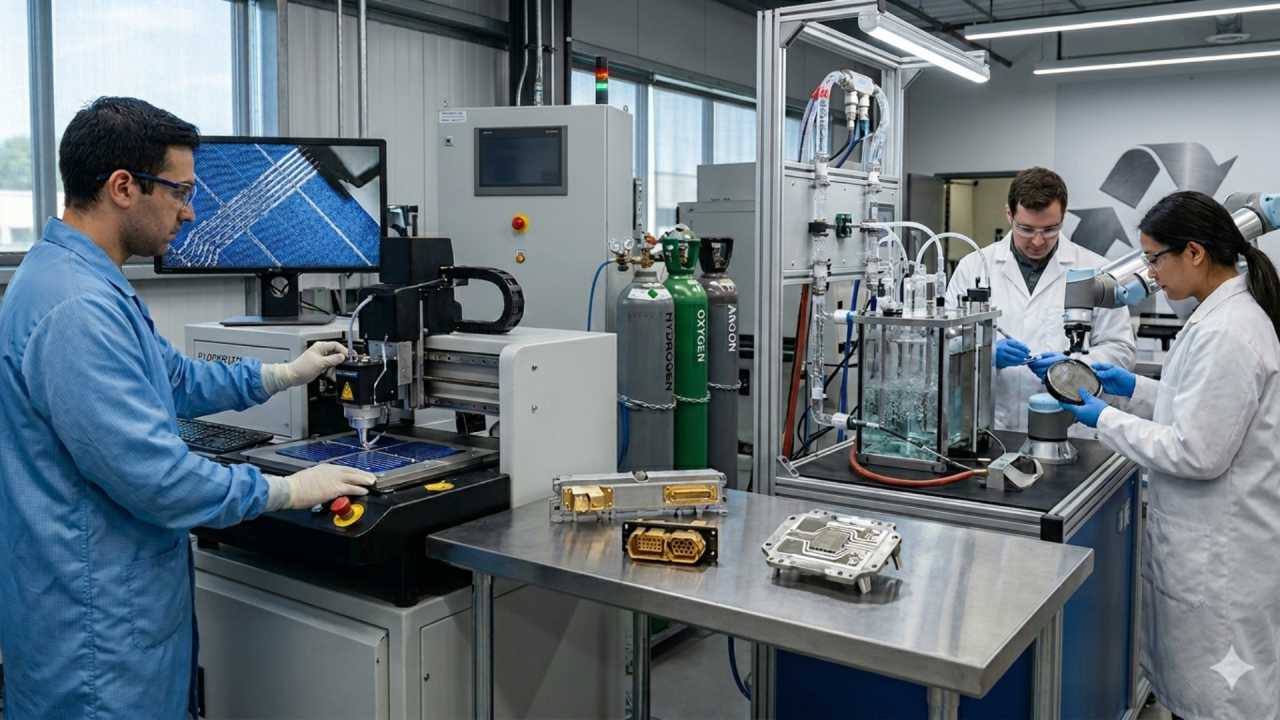
E-waste is the fastest-growing waste stream in the world. Modern circuit boards contain a “cocktail” of precious metals. Professional refiners help recyclers move beyond just “shredding” by chemically extracting gold, silver, and copper, significantly increasing the profit margin per ton of waste.
Automotive Recyclers
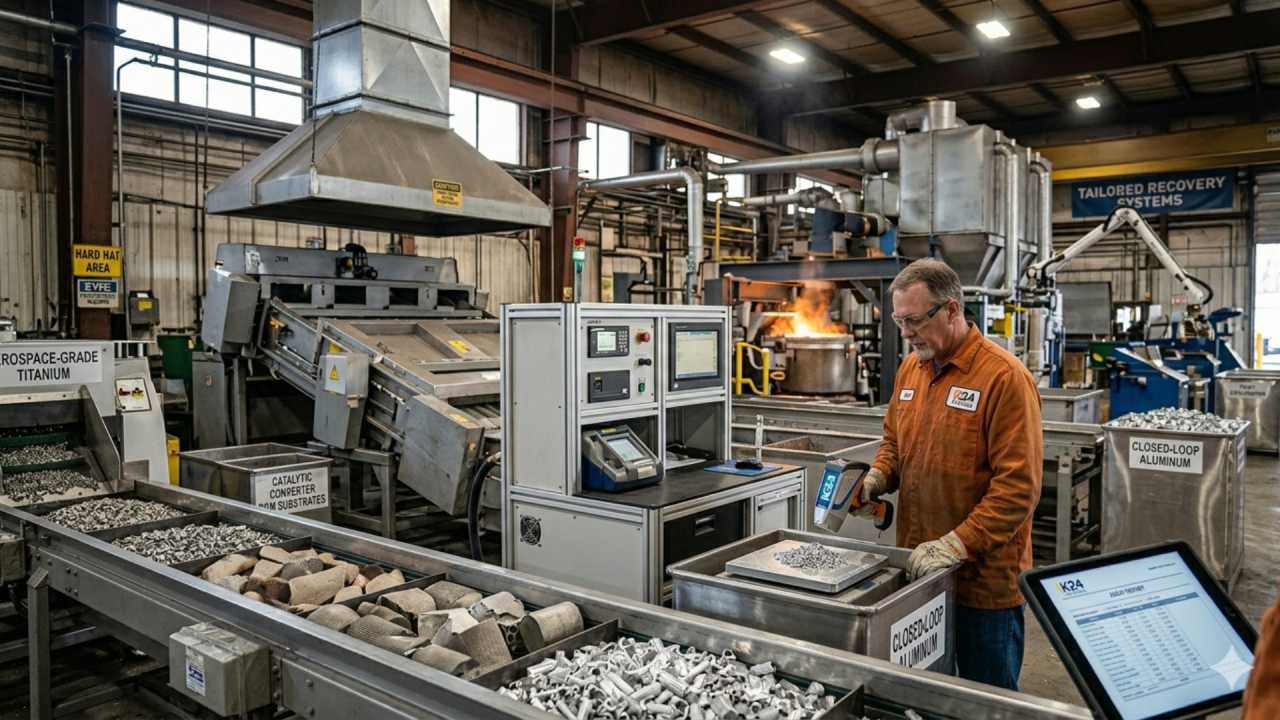
Beyond the steel and aluminum of the chassis, the catalytic converter is the “treasure chest” of a scrapped vehicle. Refiners provide the specialized equipment needed to crush the ceramic honeycomb inside these units and assay the PGM content, ensuring the recycler isn’t underpaid by opportunistic “core buyers.”
Dental and Medical Sectors
Dental labs generate scrap from crowns and bridges, while the medical device industry uses platinum and iridium in stents, catheters, and pacemakers. These materials are often discarded as medical waste unless a formal refining program is in place.
Industrial and Chemical Manufacturers
Many chemical processes use precious metal catalysts to trigger reactions. Over time, these catalysts become “poisoned” or ineffective. Refining allows these companies to recover the expensive metal substrate and reinvest the capital into fresh catalysts.
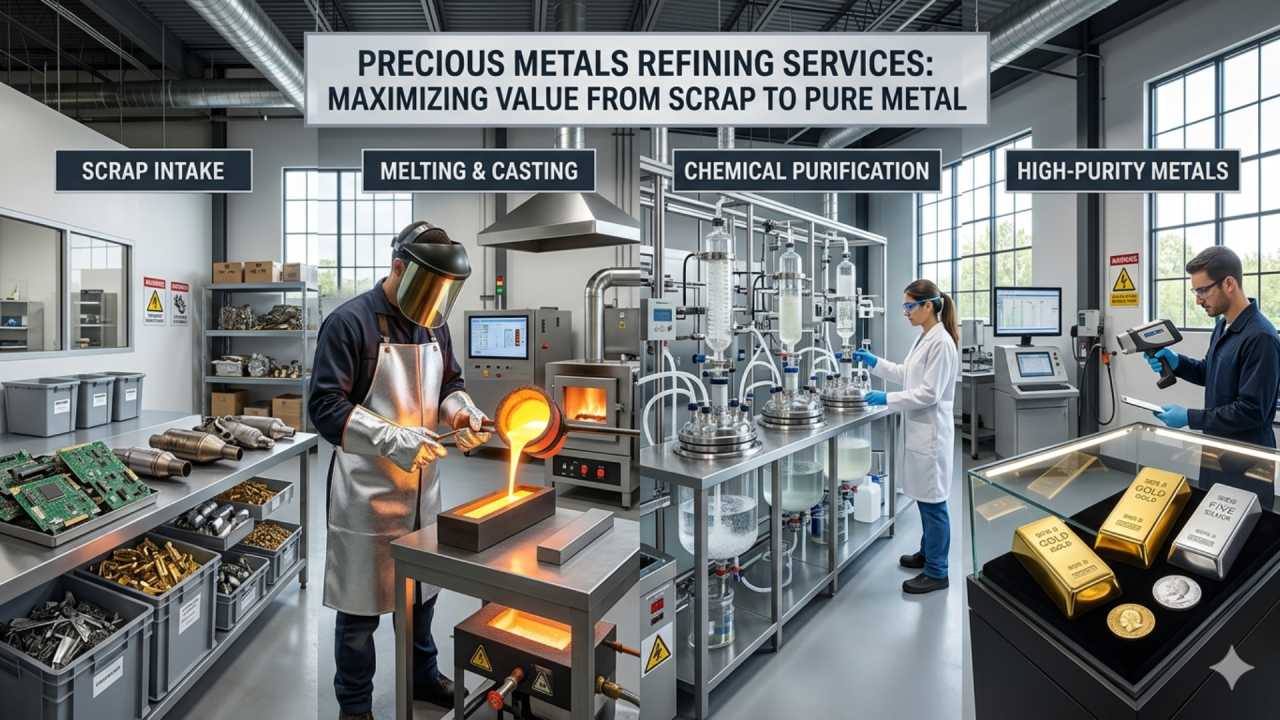
The Precious Metals Refining Process (Step-by-Step)
The refining process is a blend of heavy metallurgy and precision chemistry. Understanding these steps is crucial for ensuring transparency and accuracy.
1. Collection and Sorting
Material is received and categorized by type. A load of jewelry scrap cannot be processed the same way as a load of industrial sludge. Sorting ensures that the recovery chemistry is optimized for the specific material.
2. Sampling
Because it is impossible to assay an entire multi-ton lot at once, refiners use “sampling.” This involves creating a homogenized representation of the material—either by melting it into a uniform bar or by grinding it into a fine, consistent powder.
3. Assaying
This is the scientific heart of refining.
-
Fire Assay: The gold standard for accuracy, involving melting the sample with “flux” to separate precious metals from base metals.
-
XRF (X-Ray Fluorescence) Testing: A non-destructive method that uses X-rays to determine the elemental composition of a metal surface.
4. Melting and Smelting
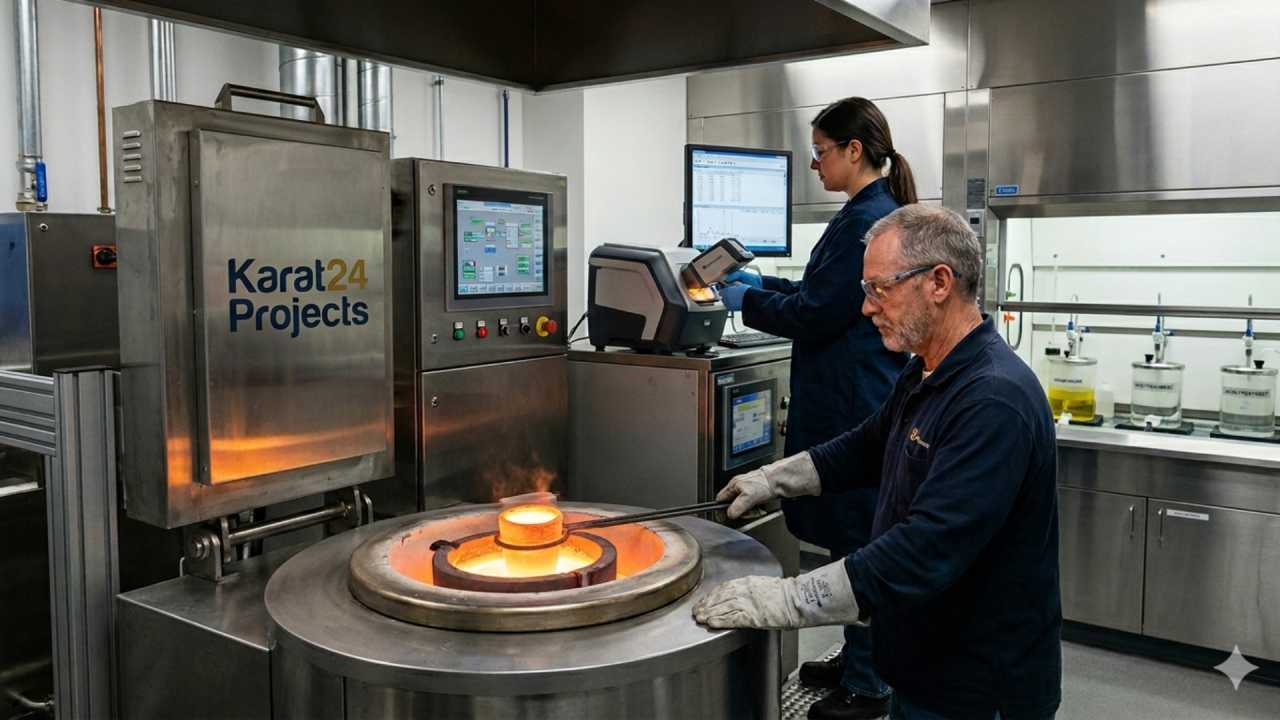
The bulk material is heated in a furnace. In smelting, chemical agents (fluxes) are added to remove impurities like oxygen, sulfur, and base metals, which float to the top as slag, leaving a “dore” bar of concentrated precious metal.
5. Chemical Refining
To reach 99.9% purity, chemical baths are used.
-
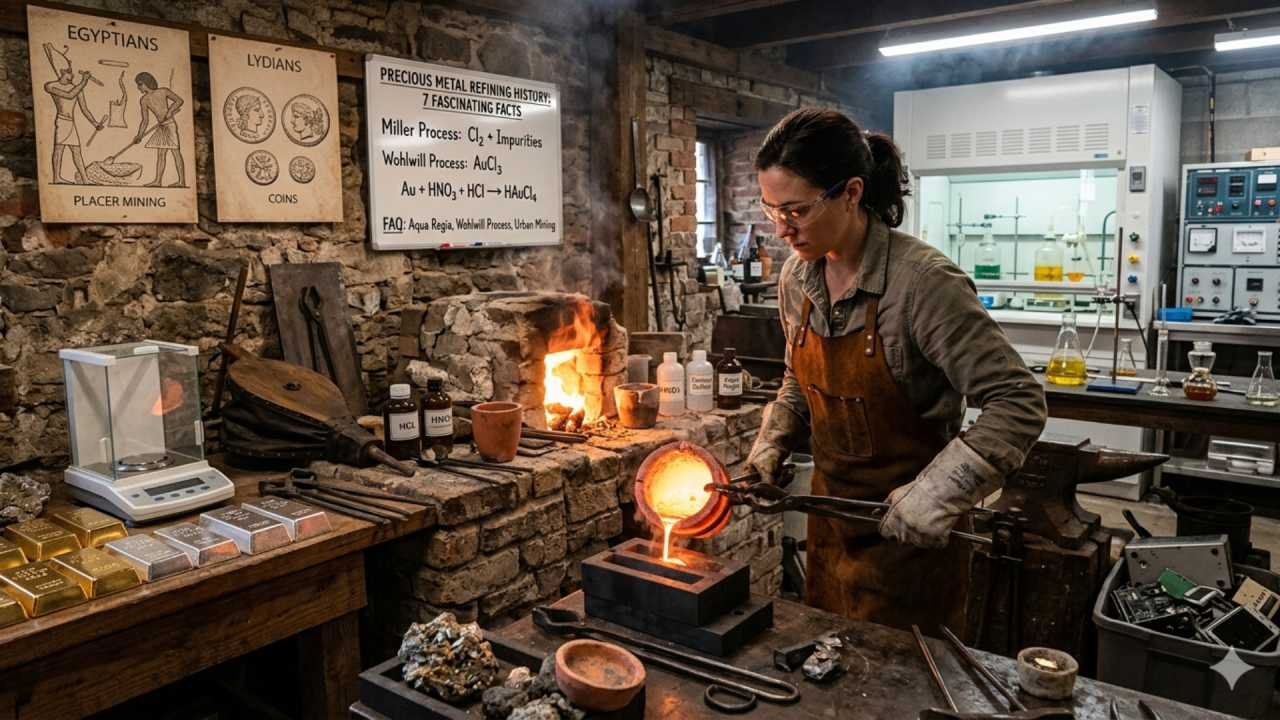
Aqua Regia: A mixture of nitric and hydrochloric acid used to dissolve gold and platinum.
-
Electrolysis: Using electrical currents to migrate pure silver or copper from an impure anode to a pure cathode.
6. Separation and Purification
Different metals precipitate out of the chemical solutions at different stages. For example, adding specific salts to an Aqua Regia solution can cause gold to “drop out” as a fine brown powder while leaving platinum in the liquid.
7. Final Testing and Settlement
Once the metal is purified, it is weighed and tested one last time. The refiner then issues a settlement report, detailing the weight of the material received, the assay results, and the final payout based on current market rates.
How Refining Maximizes Value
The primary reason to use a professional refiner is the maximization of the “Return on Investment” (ROI) from scrap materials.
Higher Payouts vs. Scrap Buyers
Scrap buyers (pawn shops, “cash for gold” kiosks) must build in a large margin of error because they do not have the equipment to know the exact purity of the material. They might pay 60% to 70% of the estimated value. A professional refiner, through precise assaying, can often pay out 90% to 99% of the contained value, minus a transparent refining fee.
Recovery of Trace Metals
In many industrial scrap loads, the primary metal (like silver) is easy to spot, but trace amounts of more expensive metals (like palladium or gold) are often overlooked. Professional refining processes are designed to capture these “byproduct” metals, which can sometimes account for 10% to 20% of the total value of the shipment.
Faster Turnaround and Cash Flow
For many businesses, capital tied up in scrap is “dead” money. Professional refiners offer expedited processing and “advances” on shipments, allowing businesses to maintain a healthy cash flow and reinvest in their operations more quickly.
Transparent Pricing
Refiners typically tie their payouts to the London Bullion Market Association (LBMA) prices. This gives the client a clear, verifiable benchmark for what their metal is worth, eliminating the guesswork and “haggling” associated with less professional buyers.
Key Factors to Consider When Choosing a Refining Partner
Not all refining services are created equal. Choosing the wrong partner can lead to lower yields, hidden fees, and legal headaches.
Reputation and Certifications
Look for refiners with long-standing reputations and memberships in industry organizations like the International Precious Metals Institute (IPMI). Check if they are compliant with AML (Anti-Money Laundering) and KYC (Know Your Customer) regulations.
Assay Transparency
A reputable refiner will allow for “witnessed sampling” or provide “split samples.” This means you can have a portion of your material tested by an independent third-party lab to verify the refiner’s results. If a refiner refuses to share assay data, it is a significant red flag.
Settlement Speed and Options
Does the refiner offer payment via wire transfer, check, or “metal return”? Some businesses prefer to have their metal returned as pure bars or grains to be used in future manufacturing. Ensure their settlement options align with your business needs.
Environmental Compliance
Refining involves hazardous chemicals and high-heat furnaces. A professional refiner must have state-of-the-art scrubbers and waste-treatment systems to comply with EPA (or equivalent) standards. Using a “back-alley” refiner can expose your business to “cradle-to-grave” liability if they mishandle hazardous waste.
Environmental and Sustainability Benefits
In the modern business landscape, sustainability is as important as profitability. Precious metals refining is a cornerstone of the Circular Economy.
Reducing Mining Demand
Mining is one of the most carbon-intensive industries on the planet. Extracting one ounce of gold can require the displacement of tons of earth and the use of massive amounts of water and cyanide. Refining recycled materials requires a fraction of the energy used in mining, significantly lowering the carbon footprint of the metal.
Ethical Sourcing
By refining secondary materials, companies can bypass the ethical concerns associated with “conflict minerals” mined in unstable regions. Recycled metal is inherently “clean” from a human rights perspective.
Responsible Waste Handling
Professional refiners ensure that the non-metallic portions of scrap (like plastics in e-waste or hazardous chemicals in industrial catalysts) are disposed of or recycled in compliance with environmental laws. This prevents toxic heavy metals from leaching into groundwater.
Risks of Not Using Professional Refining Services
Relying on informal buyers or uncertified “smelters” carries several high-stakes risks:
-
Undervalued Scrap: Without a proper assay, you are almost certainly being underpaid. Even a 2% error in gold content can result in thousands of dollars in lost revenue on a large lot.
-
Hidden Fees: Some low-tier buyers offer a “high payout percentage” but then subtract exorbitant “treatment charges,” “environmental fees,” or “assaying costs” from the final check.
-
Legal and Compliance Risks: Many precious metals are subject to strict “Chain of Custody” requirements. Dealing with unlicensed buyers can inadvertently involve your business in money laundering or the trade of stolen goods.
-
Security Issues: High-value scrap is a target for theft. Professional refiners provide insured shipping and high-security facilities to protect your assets from the moment they leave your dock.
Market Trends in Precious Metals
The value of refining services is intrinsically linked to the global commodities market. Several trends are currently making refining more lucrative than ever.
The EV Revolution
The shift toward electric vehicles (EVs) and hybrid technology has caused a massive spike in demand for silver (used in electronics) and PGMs (used in hybrid exhaust systems). Even as traditional internal combustion engines phase out, the demand for high-purity palladium and platinum for hydrogen fuel cell technology is expected to grow.
Gold as an Inflation Hedge
During periods of economic volatility, gold prices typically rise as investors seek a “safe haven.” This increases the value of every gram of jewelry scrap and dental gold, making it the perfect time for businesses to “clean out” their scrap bins.
Technological Miniaturization
As electronics become smaller and more complex, the concentration of precious metals in high-end components is actually increasing in some sectors. This makes the “yield” per pound of e-waste more attractive to specialized refiners.
Final Thoughts
The recovery of precious metals is far more than a simple recycling exercise; it is a vital industrial process that bridges the gap between waste and wealth. Whether you are a jeweler, an automotive recycler, or a medical device manufacturer, the “hidden” value in your scrap materials represents a significant opportunity to bolster your bottom line.
Professional refining services provide the scientific accuracy, security, and market access necessary to transform these materials into liquid capital. By choosing a partner that prioritizes transparency, environmental compliance, and high-yield recovery, you ensure that your business remains both profitable and sustainable.
In a world where resource scarcity is the new reality, every milligram counts. Partnering with the right refining service can transform scrap into significant revenue, providing the financial edge needed to thrive in today’s competitive market.