How On-Site Refining Helped a Local Jeweler Increase Profits
The independent retail jewelry sector has always been defined by its blend of artistry, romance, and precise craftsmanship. Yet beneath the glittering showcases and velvet displays lies a challenging business landscape. Independent jewelers navigate structural shifts that threaten their brick-and-mortar models: unprecedented volatility in gold and precious metal prices, tightening retail margins, and fierce competition from digital-first e-commerce giants operating with minimal overhead.
Compounding these pressures are operational inefficiencies within the traditional jewelry lifecycle. For decades, retail jewelers have accumulated a steady stream of precious metal scrap—including bench sweeps, polishing dust, broken trade-ins, estate pieces, and obsolete inventory. Standard practice required storing this material for months before shipping it off to distant, third-party commercial refineries.
This model forces jewelers to contend with painful delays, opaque fee structures, missing metal yields, and persistent cash flow bottlenecks. For an industry where liquidity dictates purchasing power, leaving capital locked up in a scrap bucket is a costly liability.
Faced with these compounding challenges, one progressive local jeweler chose to break the cycle. By integrating an innovative, closed-loop, on-site precious metal refining operation directly into their retail and workshop footprint, they transformed their cost structure and customer value proposition. This deep dive examines how transitioning to in-house refining unlocked faster turnarounds, captured higher profit margins, bolstered customer confidence, and maximized inventory control, presenting a scalable blueprint for modern jewelry profitability.
What Is On-Site Refining?
To understand how this operational shift drives profitability, it is essential to define what on-site refining entails and how it differs from traditional methods.
In a standard retail jewelry setting, “scrap” metal is treated as an accumulation of dormant capital. Jewelers routinely gather various forms of precious metal byproducts, which generally fall into two categories:
High-Grade Scrap
-
Customer Trade-Ins and Estate Buy-Ins: Worn, broken, or outdated consumer jewelry, class rings, and dental gold.
-
Bench Scrap: Clean sizing cuts, sprues, miscasts, and clipping remnants generated during custom manufacturing and repairs.
Low-Grade Scrap (“Sweeps”)
-
Polishing Dust: Microscopic particles of precious metal sheared off during polishing wheels, captured by vacuum collection systems.
-
Floor Sweeps and Grindings: Material gathered from the workshop floor, bench mats, and sink traps.
Traditionally, a jeweler fills a box with these materials and ships them to a commercial refinery. The external refiner melts the lot, assays a sample, applies a multi-layered fee structure (including processing fees, assay fees, and environmental surcharges), and returns a settlement check or pure bullion weeks later.
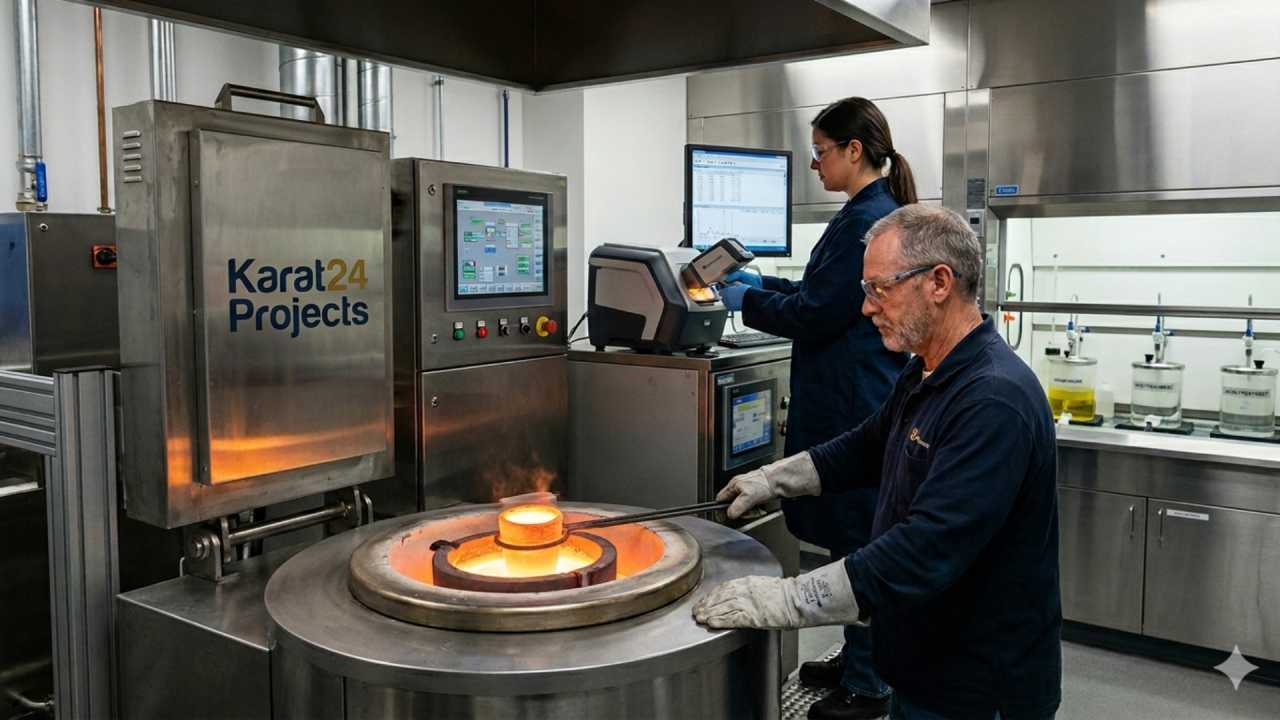
On-site refining brings this entire chemical and metallurgical lifecycle in-house. Utilizing modern, scaled-down refining technology engineered for safety and precision, the jeweler retains complete control over the extraction, separation, and purification of precious metals on their own premises.
The core workflow consists of four basic phases:
-
Melting: Consolidating miscellaneous scrap into a homogeneous alloyed bar using a high-frequency induction furnace.
-
Assaying: Determining the precise elemental composition of the melt via acid testing, hydrostatic weighing, or advanced X-ray Fluorescence (XRF) analysis.
-
Separation: Utilizing specialized chemical or electrochemical processes to isolate gold, silver, and platinum-group metals from base metal contaminants like copper, zinc, and nickel.
-
Purification: Refining the isolated precious metals up to a purity level of 99.9% (fine gold or silver), ready to be cast into casting grain, wire, or sheet metal for immediate production.
The Jeweler’s Situation Before Refining
Before pivoting to an in-house model, our local jeweler operated a successful storefront with a busy custom-design and repair department. However, their back-end scrap management was a source of financial friction.
The store relied entirely on a traditional regional refiner for processing their gold scrap and bench sweeps. This dependency introduced several vulnerabilities into their business:
Capital Stagnation
To justify the shipping costs, insurance premiums, and minimum batch requirements imposed by the commercial refinery, the jeweler had to wait until they accumulated at least 20 to 30 ounces of clean gold scrap, and up to six months for low-grade sweeps. This meant thousands of dollars in raw materials sat idle in a back-office safe, completely removed from the store’s working capital cycle.
Opaque Settlements and Hidden Fees
Every refinery shipment felt like a gamble. The jeweler would carefully weigh their scrap, but the final settlement sheets from the third-party refiner rarely matched their internal estimates.
External refiners apply a cascade of subtractions: a percentage discount on the total gold yield (often retaining 2% to 8% of the metal value), upfront melt fees, assay charges, and shipping charges. When refining low-grade sweeps or polishing dust, these fees routinely devoured up to 15% to 20% of the gross value, making it difficult to verify if the business was receiving an honest return.
Extended Cash Flow Bottlenecks
Once a batch was shipped, the settlement period spanned anywhere from two to six weeks. During peak inventory buying seasons, such as the run-up to the holidays, this delay squeezed the store’s liquidity. The jeweler was frequently forced to rely on high-interest lines of credit to finance new inventory purchases while waiting for their own gold settlements to clear.
Customer Acquisition Friction
When local consumers brought in old family gold or estate jewelry to trade in or sell, the jeweler had to build a significant safety cushion into their offers. Because they could not definitively verify the exact karat purity of non-hallmarked pieces on the spot, and because they knew a third-party refiner would take a cut downstream, the jeweler offered customers 60% to 70% of the spot gold price.
This conservative pricing structure caused them to lose competitive buy-in opportunities to specialized gold buyers and online storefronts that aggressively advertised higher payouts.
Why This Jeweler Switched to On-Site Refining
The decision to transition to on-site refining was born out of a desire for greater operational transparency and vertical integration. The jeweler realized that by outsourcing their refining, they were giving away the most profitable segment of their supply chain.
Several strategic priorities drove the investment in an in-house refining setup:
| Strategic Driver | Operational Objective |
| Margin Maximization | Eliminate third-party processing fees and retain 100% of the precious metal yield. |
| Instant Liquidity | Accelerate the recycling loop from months to hours, freeing up locked working capital. |
| Internal Sustainability | Establish a closed-loop production cycle to manufacture custom jewelry using recycled gold. |
| Enhanced Customer Experience | Offer transparent, on-the-spot metal evaluations to boost consumer trust and capture market share. |
Practical execution required careful planning. The jeweler evaluated equipment footprints, environmental safety, regulatory compliance, and staff training. Rather than adopting outdated, hazardous acid-boiling methods, they invested in a self-contained, automated chemical refining system equipped with integrated scrubbing units to neutralize fumes.
They cross-trained their head bench jeweler on precise metallurgical processing and updated their commercial insurance policy to cover the specialized equipment. By treating refining as an institutional discipline rather than a backroom hobby, the store prepared itself for a fundamental financial shift.
How the Refining Process Works in Practice
Integrating a micro-refinery into an active jewelry store requires an organized, multi-step operational workflow. Here is how our local jeweler structured their daily and weekly refining protocols to maximize safety, precision, and yield:
Phase 1: Receiving and Sorting
The process begins with strict material categorization. High-grade scrap gold is sorted by its stamped karats (10k, 14k, 18k) using fundamental testing methods, such as acid scratch tests or electrical conductivity pens.
Any gemstones remaining in the scrap jewelry are left intact; the in-house chemical refining process gently dissolves the surrounding metal, allowing diamonds, sapphires, and rubies to be recovered completely undamaged at the bottom of the refining vessel—a massive advantage over manual stone removal.
Phase 2: Melting and Assaying
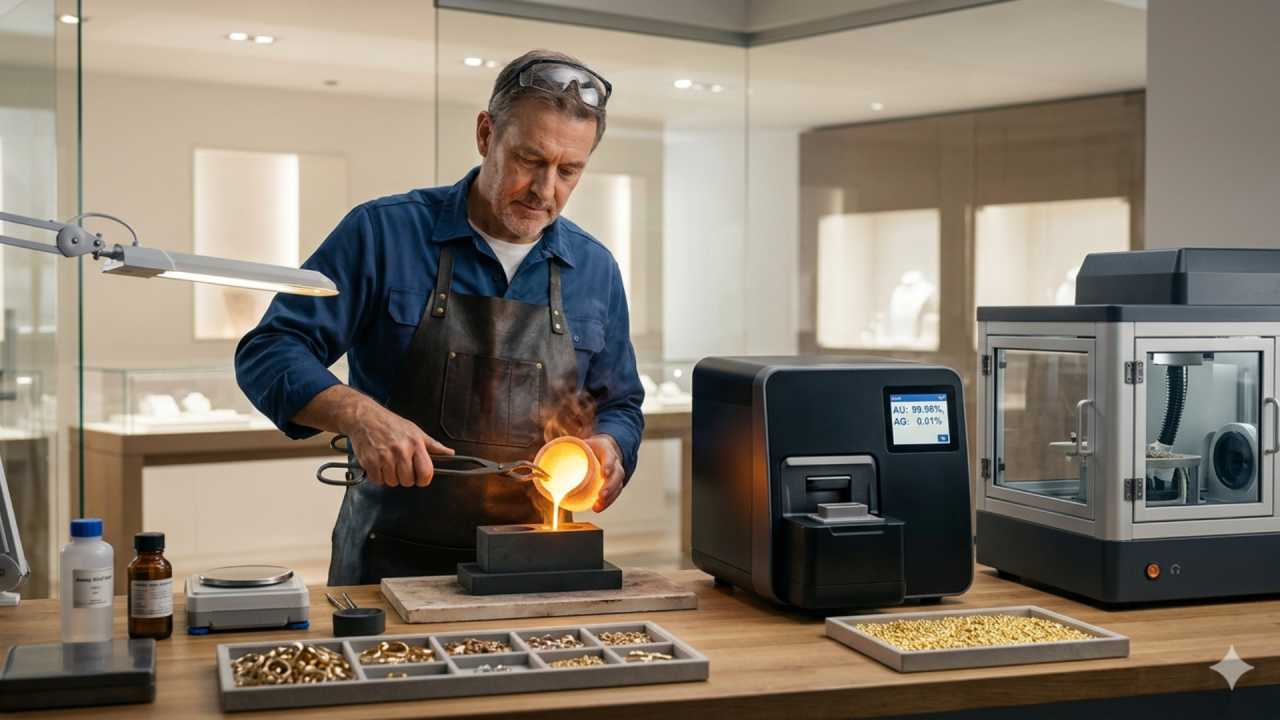
Once sorted, the scrap metal is placed into a compact, benchtop induction melting furnace. Capable of reaching temperatures over 1,100°C in minutes, the induction furnace uses electromagnetic fields to stir the molten metal, ensuring a completely homogeneous alloy.
The molten gold is poured into a graphite ingot mold to create a smooth, unified sample bar. The jeweler then uses a modern, desktop XRF (X-ray Fluorescence) analyzer. By firing a non-destructive X-ray beam at the bar, the device provides an instantaneous, laboratory-grade elemental readout detailing the exact percentage of gold, silver, platinum, copper, and zinc present.
Phase 3: The Refining Process
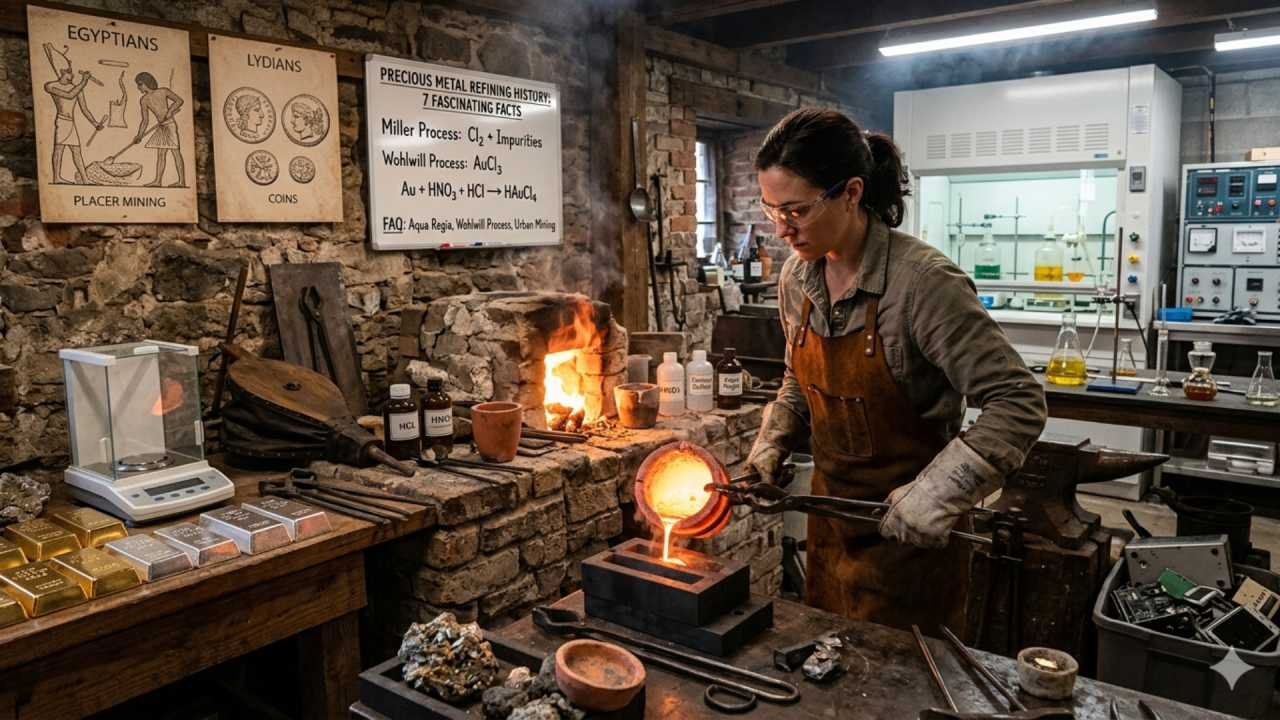
With the exact composition established, the metal moves to a closed-loop chemical refining station. The jeweler utilizes a modern aqua regia or simplified chemical salt procedure tailored for small-batch applications. The alloyed bar is dissolved in a controlled solution, converting the gold into a liquid compound (tetrachloroauric acid) while precipitating silver out as a solid silver chloride compound.
Once the gold is entirely in solution, a selective precipitating agent—such as sodium metabisulfite—is added. This compound reacts exclusively with the gold ions, causing them to bond together and drop out of the liquid as a heavy, brown, 99.99% pure gold powder. The remaining liquid containing base metals is safely filtered off, neutralized, and disposed of according to local environmental regulations.
Phase 4: Reuse or Resale
The refined gold powder is rinsed, dried, and returned to the induction furnace. It is melted down one final time and poured into water to create clean, bright 24k gold casting grain, or poured into molds to form certified pure investment bullion bars.
The entire process, from a pile of mismatched scrap jewelry to pure, usable 24k gold grain, takes less than four hours.
Profit Improvements the Jeweler Experienced
The financial impact of transitioning to an on-site refining model was immediate and visible across the jeweler’s balance sheet. Within the first twelve months of operation, the store documented measurable profit improvements across five core financial vectors.
1. Eliminating Third-Party Capital Drag
By cutting out external refiners, the jeweler instantly eliminated the 5% to 12% value loss previously absorbed by processing fees and discounted assay yields. Every milligram of precious metal recovered from bench sweeps and trade-ins remained inside the company’s ecosystem.
On an annual volume of approximately 400 ounces of scrap gold, saving an average of 8% in fees equated to retaining an extra 32 ounces of pure gold. At a spot price of $2,000 per ounce, this single operational shift added $64,000 directly to the bottom line.
2. Radical Acceleration of Cash Flow and Liquidity
Instead of waiting weeks for an external check, the jeweler achieved same-day asset conversion. Scrap gold accumulated from customer trade-ins on a Saturday morning could be processed, refined, and converted into pure casting grain by Monday afternoon.
This hyper-efficient recycling loop drastically reduced the store’s reliance on outside suppliers for raw manufacturing materials, minimized interest expenses on raw gold credit accounts, and allowed the business to reallocate capital dynamically.
3. Exploiting Competitive Payout Margins to Drive Foot Traffic
Armed with a desktop XRF analyzer and an on-site refining setup, the jeweler revolutionized their consumer gold-buying program. Because they knew their exact operational refining costs were negligible, they raised their public payout rate from 65% of spot value to an aggressive 82% to 85%.
They launched a targeted local marketing campaign: “Transparent Gold Buying—Watch Your Jewelry Assayed Live and Get Paid Maximum Value Instantly.”
“By raising our consumer gold-buying payouts to 85% of spot value, we didn’t just outbid local pawnshops—our total over-the-counter buy volume increased by 140% in six months, transforming our scrap intake into a high-margin revenue engine.”
This transparent approach drew a steady influx of high-volume estate sellers and retail consumers. While competitors hesitated over unknown karat percentages, this jeweler provided definitive readouts and immediate cash or store credit options. The increased foot traffic led to a secondary surge in retail sales, as many gold sellers rolled their immediate payouts into purchases of new custom jewelry or diamond upgrades.
4. Direct Cost Reduction in Custom Manufacturing
Before implementing the in-house system, the jeweler purchased fine gold casting grain from national bullion banks and findings manufacturers, paying a premium over the spot market price.
Post-integration, the store became entirely self-sufficient for its custom jewelry fabrication. They alloyed their in-house refined 24k gold down to 14k or 18k white, yellow, and rose gold grain right at the bench. This eliminated fabricator premiums, lowering the raw material cost of their custom design catalog by 4% to 6%, which widened their gross retail margins on custom creations.
5. Monetizing B2B Refining Services
As word spread within the local regional trade network, neighboring independent repair shops and boutique designers who lacked the capital to invest in on-site technology approached our jeweler.
The jeweler capitalized on this by offering rapid-turnaround B2B refining services for small-batch trade-ins and polishing sweeps, charging a flat 5% processing fee. This turned a tool initially intended for internal cost containment into a steady, secondary B2B revenue stream.
Unexpected Benefits Beyond Profit
While the financial metrics justified the initial investment, the jeweler experienced several qualitative, brand-building advantages that transformed their market positioning.
Trust as a Market Differentiator
In the jewelry industry, consumer trust is paramount. Historically, the process of buying back gold or valuing estate jewelry occurred behind closed doors, creating a natural sense of consumer skepticism.
By positioning the XRF analyzer and a viewing window into the melting room right near the showroom floor, the jeweler transformed a clinical chemical process into a compelling retail experience. Customers enjoyed watching their old, broken items transformed into a glowing molten pour, followed by an immediate computer-generated readout of its composition. This radical transparency earned the store a reputation as the most honest and advanced dealer in the region.
Capitalizing on the “Circular Economy” and Sustainability
Modern consumers—particularly Millennials and Gen Z—prioritize environmental responsibility and ethical sourcing when purchasing luxury goods. The jewelry industry frequently faces scrutiny regarding the environmental impacts of dirty mining practices.
Our jeweler leveraged their on-site refining capabilities as a core marketing pillar, introducing a curated line of “100% Locally Recycled Heritage Fine Jewelry.”
They educated their market on how their custom designs required zero new mining footprint, using exclusively gold recovered and purified right inside the store. This sustainable narrative resonated deeply with young bridal couples, allowing the jeweler to command premium branding positions without increasing raw material costs.
Insulating the Business from Volatile Supply Chains
Geopolitical tensions, shipping disruptions, and economic shifts frequently cause sudden spikes in precious metal premiums and delivery timelines. By maintaining an internal inventory of refined gold grain, the store insulated its workshop from external supply chain shocks. When global delivery networks slowed down, the store’s bench jewelers continued custom fabrications uninterrupted, utilizing metal harvested directly from local trade-ins.
Challenges and Risks of On-Site Refining
Despite the clear strategic benefits, establishing an on-site refining operation is not an easy plug-and-play solution. It represents an intricate operational pivot that brings serious risks if mismanaged.
Our jeweler had to carefully navigate several critical challenges during the implementation phase:
Capital Expenditure and Equipment Costs
The initial barrier to entry is financial. A precise, safe, and legally compliant on-site refining setup requires a meaningful capital investment.
| Equipment / Requirement | Cost (USD) |
| Desktop XRF Elemental Analyzer | $15,000 |
| Induction Melting Furnace | $4,500 |
| Closed Chemical Refining Unit | $8,000 |
| Fume Scrubber & Venting System | $5,500 |
| Compliance & Safety Training | $3,000 |
| Total Estimated Investment | $36,000 |
For small, low-volume boutiques, amassing this upfront capital can severely strain cash reserves. Our jeweler projected an eighteen-month payback period based on their scrap volume, a target they beat due to their expanded gold-buying program.
Regulatory Compliance and Environmental Safety
Chemical refining involves hazardous agents and high temperatures. Operating a refining system requires strict adherence to local environmental protection laws, OSHA regulations, and municipal fire codes. The jeweler had to install dedicated venting infrastructure and advanced acid-fume scrubbers to ensure no toxic gasses escaped into the retail store or surrounding neighborhood.
Additionally, buying gold from the public requires compliance with federal Anti-Money Laundering (AML) laws and USA PATRIOT Act regulations, demanding meticulous record-keeping, customer identification protocols, and regular compliance audits.
Personnel Allocation and Training Risks
Refining precious metals is a rigorous science. Simple mistakes—such as improper chemical ratios, inadequate filtering, or temperature mismanagement—can result in catastrophic metal losses, contaminated batches, or dangerous chemical spills.
The jeweler had to commit valuable staff hours to training. Dedicating an experienced bench jeweler to refining meant temporarily taking them away from profitable repair tasks, requiring careful scheduling to maintain workshop productivity.
Security Concerns
Housing an operational refinery that processes high-purity precious metals increases a store’s risk profile for burglary and internal shrinkage. The jeweler had to upgrade their security infrastructure, installing high-definition surveillance cameras inside the refining room, upgrading to a high-security TL-30×6 rated commercial safe, and rewriting internal inventory control audits to track scrap weights through every single phase of the chemical transformation.
Is On-Site Refining Right for Every Jeweler?
The success story of this local independent jeweler proves that on-site refining can be an exceptional profit accelerator under the right operational conditions. However, this business model is not a universal fit for every retail jewelry store. Deciding to bring refining in-house requires an honest analysis of a store’s volume, business model, and operational strengths.
Ideal Fit For
-
High-Volume Custom Design Houses: Showrooms that generate substantial quantities of internal bench scrap, sprues, and sizing dust benefit directly by instantly converting waste back into usable production grain.
-
Aggressive Gold-Buying Operations: Stores located in high-traffic areas that actively buy significant volumes of estate pieces, scrap jewelry, and dental gold from the public can leverage immediate assays to maximize cash flow.
-
Multi-Location Regional Chains: Jewelers who can establish a centralized refining hub at one master location to service several satellite storefronts can easily distribute the upfront equipment costs across a high corporate volume.
Unsuitable For
-
Low-Volume, Curation-Only Boutiques: Storefronts focused entirely on retailing finished designer jewelry lines, with little to no on-site bench repair or custom work, will struggle to accumulate enough raw scrap to justify the equipment overhead.
-
Leased Malls and Ultra-Dense Retail Spaces: Malls and strictly regulated commercial real estate developments frequently enforce restrictive lease terms that prohibit the installation of chemical venting hoods, induction furnaces, or bulk chemical storage.
The Hybrid Alternative
For jewelers who find themselves in the middle ground—possessing enough scrap volume to feel the financial sting of traditional refining fees, but lacking the space, capital, or desire to run an in-house chemical plant—a hybrid refining model is an excellent alternative.
Under a hybrid strategy, the jeweler invests exclusively in a compact induction melting furnace and a high-quality desktop XRF analyzer. Instead of refining chemically on-site, the jeweler melts their scrap down into a single, homogeneous bar and assays it themselves.
They then ship this unified bar to a transparent commercial refinery. Because the jeweler already knows the exact elemental composition of the bar down to the third decimal place before it leaves their store, they eliminate any chance of settlement discrepancies or hidden yield reductions. This hybrid approach delivers 80% of the transparency benefits of full on-site refining at a fraction of the equipment cost and regulatory complexity.
Final Thoughts: The Future of Jewelry Profitability
The modern retail landscape leaves little margin for error. As traditional jewelry retail strategies become increasingly commoditized by online operations, long-term survival demands that independent storefronts innovate, seek out hidden efficiencies, and maximize the utility of every asset at their disposal.
The case study of this local jeweler demonstrates that on-site precious metal refining is far more than an interesting workshop upgrade. It represents a fundamental strategic shift toward vertical integration. By reclaiming control over their scrap metal lifecycle, this independent business wiped out third-party fees, unlocked immediate liquidity, turned their consumer gold-buying program into a dominant local engine, and built a sustainable brand narrative that resonates with modern consumers.
As technology continues to advance, bringing precision analytical and metallurgical equipment into smaller footprints, the financial arguments for in-house refining become undeniable. For forward-thinking jewelers willing to navigate the initial learning curves and regulatory frameworks, turning a retail store into a closed-loop micro-refinery offers an effective way to protect margins, build trust, and secure lasting profitability.
Frequently Asked Questions About In-House Jewelry Refining
Is it legal to refine gold on-site at a retail jewelry store?
Yes, it is entirely legal to refine gold on-site, provided you comply with localized environmental, zoning, and financial regulations. Retail jewelers must adhere to the Clean Air Act by installing appropriate gas scrubbers to neutralize acidic emissions. Additionally, if you buy gold from the public to refine, you must establish an Anti-Money Laundering (AML) compliance program under the USA PATRIOT Act to prevent illicit transactions. Always check with your municipal fire marshal regarding chemical storage limits in commercial retail zones.
What is the best equipment for a small business to refine precious metals?
For a small to mid-sized retail jewelry store, the best equipment setup prioritizes safety and non-destructive analysis over heavy industrial capacity. A complete professional setup typically includes:
-
A desktop X-ray Fluorescence (XRF) analyzer for instantaneous, laboratory-grade purity readouts.
-
A compact benchtop electric induction furnace to melt scrap into homogenous bars rapidly without the noise or hazards of large gas torches.
-
A self-contained, closed-loop chemical refining system with built-in fume hoods and scrubbers to safely isolate and precipitate pure gold.
How much money does a jeweler save by recycling scrap gold in-house?
By eliminating third-party refiner commissions, assay minimums, hidden melting losses, and shipping fees, a jeweler typically saves between 6% and 12% of the gross value of their metal scrap. For example, a store processing 400 ounces of gold scrap annually can recover an extra 24 to 48 ounces of pure gold. At a spot price of $2,000 per ounce, this translates directly to $48,000 to $96,000 added back to the business’s bottom line each year.
Can you chemically refine gold without using hazardous aqua regia acids?
While traditional high-purity refining relies on aqua regia (a potent mix of nitric and hydrochloric acid), modern manufacturers have engineered alternative chemical salt compounds and safer, pre-packaged solution kits tailored for small workshops. These setups replace boiling open acids with enclosed chemical reactions that drop pure gold powder out of solution cleanly, minimizing both hazardous fumes and handling risks for the bench jeweler.
How do on-site gold buying programs impact local jewelry store marketing?
An on-site gold buying program completely changes your local market positioning by transforming a transactional interaction into an educational experience. When customers can watch their heirloom or broken jewelry melted and analyzed via XRF technology right in front of them, it builds absolute trust. Jewelers can leverage this transparency in local SEO and social media campaigns to offer higher, more accurate payouts than local pawnshops or online “mail-in” services, which heavily drives retail foot traffic and custom design inquiries.
Is an XRF analyzer worth the investment for a small independent jeweler?
Yes, a desktop XRF analyzer is widely considered one of the highest-ROI equipment investments for independent jewelers. While the upfront cost typically ranges from $12,000 to $17,000, it pays for itself by preventing expensive buying mistakes. It allows you to instantly identify under-karated jewelry, counterfeit bullion, or plated metals over the counter, while giving you the exact chemical breakdown needed to price estate buy-ins with total precision.